Introduction
Festivals create valuable opportunities for Indian businesses to connect with customers, promote seasonal offers and increase sales. From Diwali and Dussehra to Ganesh Chaturthi, Christmas and New Year, customers actively look for gifts, clothing, electronics, food, travel packages and special deals. However, businesses also face intense competition during these periods, making timely and relevant communication essential.
Festive season SMS marketing helps businesses announce offers, share discount codes, remind customers about upcoming sales and bring existing buyers back to their stores. When combined with audience segmentation, a clear offer and a relevant call to action, SMS can become an effective part of a seasonal marketing strategy.
For businesses planning a Diwali promotion, our guide to the Diwali SMS campaign explains how to plan festival-specific messaging, promotional offers and customer communication. Businesses can also use a reliable WhatsApp marketing service to complement SMS campaigns with product catalogues, promotional creatives, conversational engagement and customer enquiries.
The best festive campaign is not simply a message sent to thousands of people. It is a coordinated plan that reaches the right audience, communicates a compelling reason to act and makes it easy for customers to complete their purchase.
In this guide, we cover practical festive marketing ideas, ready-to-use SMS and WhatsApp message examples, campaign planning, industry-specific strategies, performance measurement and important compliance considerations for businesses in India.
What Is Festive Season SMS Marketing?
Festive season SMS marketing is the practice of using text messages to communicate festival-related offers, product announcements, seasonal discounts, event invitations and purchase reminders to customers.
Businesses can use it before, during and after a festival to achieve different objectives.
Before the festival: Build awareness, announce upcoming offers and generate interest.
During the festive period: Promote limited-time deals, encourage purchases and share relevant updates.
After the festival: Thank customers, collect feedback and encourage repeat purchases.
For example, a clothing retailer may announce a festive collection two weeks before Diwali, send a discount message when the sale begins and remind interested customers before the offer expires.
Unlike a general festival greeting, a promotional campaign should have a clear business objective. Depending on the campaign, that objective could be increasing store visits, generating qualified enquiries, selling seasonal products, recovering abandoned purchases or encouraging repeat orders.
Why Should Indian Businesses Use Festive Season SMS Marketing?
Indian festivals often influence shopping decisions across retail, food, jewellery, electronics, education, hospitality and other industries. A well-planned messaging campaign allows businesses to communicate directly with customers when their products or services are relevant.
1. Reach customers with timely offers
SMS is useful for communicating concise information such as a sale announcement, discount code, booking deadline or store opening update.
For example, an electronics retailer can announce a weekend offer before a major festival, giving customers time to compare products and plan their purchases.
2. Encourage repeat purchases
Existing customers already know something about your business. A relevant festive offer can give them a reason to return.
A beauty brand might offer an exclusive festive gift set to previous buyers, while a restaurant could send a seasonal menu announcement to customers who have opted in to promotional messages.
3. Support local and regional campaigns
Businesses with multiple outlets can tailor their campaigns by city, language, store location or customer preference.
A retailer in Maharashtra might create Marathi and English versions of a festive message, while a business serving customers across India may use different regional campaigns based on its audience.
4. Complement other marketing channels
SMS can work alongside WhatsApp, email, paid advertising, social media and a business website.
For instance, a business could use social media to introduce a festive collection, SMS to announce when the sale starts and WhatsApp to share product images with customers who have agreed to receive messages there.
Each channel should have a distinct role rather than repeating the same promotion everywhere.
5. Measure campaign performance
With campaign-specific links, discount codes and tracking parameters, businesses can evaluate whether their festive messages generate website visits, enquiries, bookings or sales.
This makes it easier to identify which offers and audience segments deserve more attention during the next campaign.
10 Festive Season SMS Marketing Ideas for Indian Businesses
The most effective campaign ideas connect the festival to a genuine customer need. Here are ten approaches businesses can adapt for their next seasonal promotion.
1. Launch a festive sale announcement
Announce the offer before customers make their purchase decisions. Include the benefit, the start date and a clear next step.
Example:
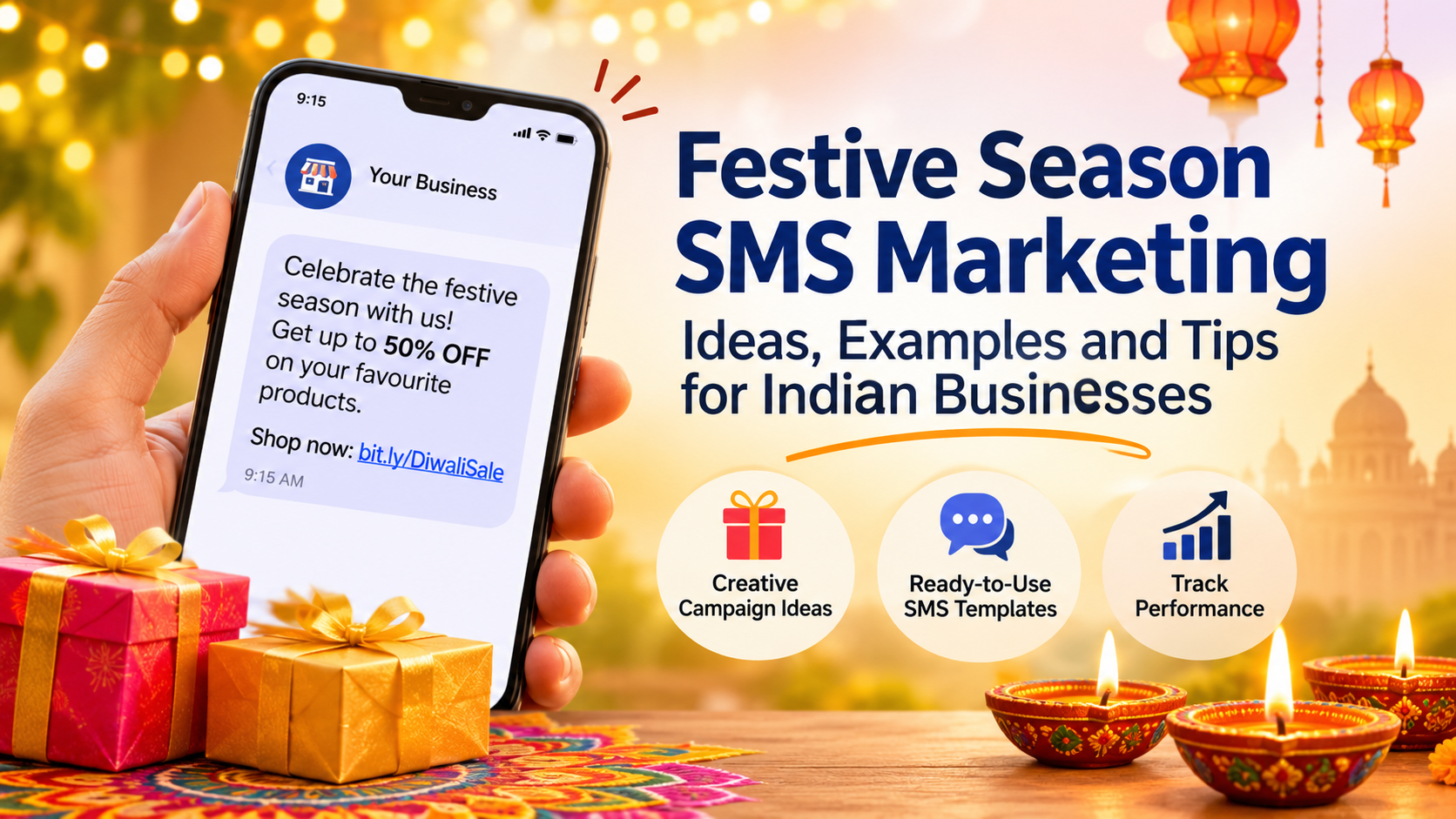
“Celebrate the festive season with [Brand Name]! Enjoy up to [X]% off selected products from [Start Date] to [End Date]. Explore the collection: [Link]”
Best for: Retail stores, fashion brands, electronics retailers and e-commerce businesses.
2. Offer early access to existing customers
Give returning customers an opportunity to shop before a public sale begins. Early access can help businesses reward customer loyalty without discounting every product for everyone.
Example:
“Your festive shopping starts early! Get exclusive early access to [Brand Name]’s festive collection. Shop from [Date]: [Link]”
Best for: Jewellery stores, apparel brands, premium retailers and customer loyalty programmes.
3. Share festival greetings with a relevant offer
A festival greeting can strengthen a customer relationship. If you include a promotion, keep it secondary to the greeting and make the commercial purpose clear.
Example:
“Wishing you and your family a joyful and prosperous Diwali from [Brand Name]. Celebrate with our special festive collection: [Link]”
Best for: Local retailers, service providers, restaurants and established customer relationships.
4. Promote limited-period discounts
A genuine deadline can motivate customers who are already considering a purchase. Avoid false countdowns or misleading scarcity claims.
Example:
“Our festive offer ends on [Date]! Save [X]% on eligible products at [Brand Name]. View the offer and terms: [Link]”
Best for: E-commerce stores, electronics shops, fashion retailers and seasonal product sellers.
5. Announce new festive products
Customers may be interested in new collections even when they are not actively searching for discounts.
Example:
“Our festive collection is here! Discover new arrivals, seasonal favourites and gift ideas from [Brand Name]. Explore now: [Link]”
Best for: Fashion, home décor, jewellery, gifting and beauty brands.
6. Promote festival gift packages
Make gift selection easier by presenting curated packages at different price points.
Example:
“Looking for festive gifts? Explore thoughtfully curated gift boxes from [Brand Name], with options for every occasion. Browse our collection: [Link]”
Best for: Corporate gifting companies, sweet shops, bakeries, gift stores and home décor businesses.
7. Drive store visits with local offers
Businesses with physical outlets can use location-specific messages to encourage nearby customers to visit.
Example:
“Your festive shopping destination is closer than you think! Visit [Store Name] at [Location] and explore our special festive offers until [Date].”
Best for: Supermarkets, showrooms, restaurants and local retailers.
8. Recover incomplete purchases
Where appropriate permissions and channel rules allow, remind customers who have started but not completed an online purchase. The message should be helpful rather than intrusive.
Example:
“Still considering your festive picks? Your selected items may still be available at [Brand Name]. Review your order here: [Link]”
Best for: E-commerce brands and online booking businesses.
9. Promote festive events and bookings
Businesses offering experiences or appointments can use messages to share event details, registration links and booking deadlines.
Example:
“Celebrate the festive season with [Event Name] at [Venue] on [Date]. Check event details and available bookings: [Link]”
Best for: Hotels, restaurants, event organisers, entertainment venues and travel companies.
10. Encourage post-festival repeat purchases
The campaign does not need to end when the festival is over. Use follow-up communication to thank customers, request feedback or introduce relevant next-season offers.
Example:
“Thank you for celebrating with [Brand Name]! We hope you enjoyed your purchase. Explore our latest collection and stay connected: [Link]”
Best for: Retailers, hospitality brands, service businesses and customer loyalty programmes.
Ready-to-Use Festive SMS Templates
Businesses can adapt the following messages by replacing the placeholders with accurate offer details. Ensure the final text matches the applicable registered template and communication requirements before sending commercial SMS in India.
Campaign type | SMS template |
|---|---|
Festive sale | “[Brand Name]: Celebrate the season with [X]% off selected products until [Date]. Explore the offer: [Link]” |
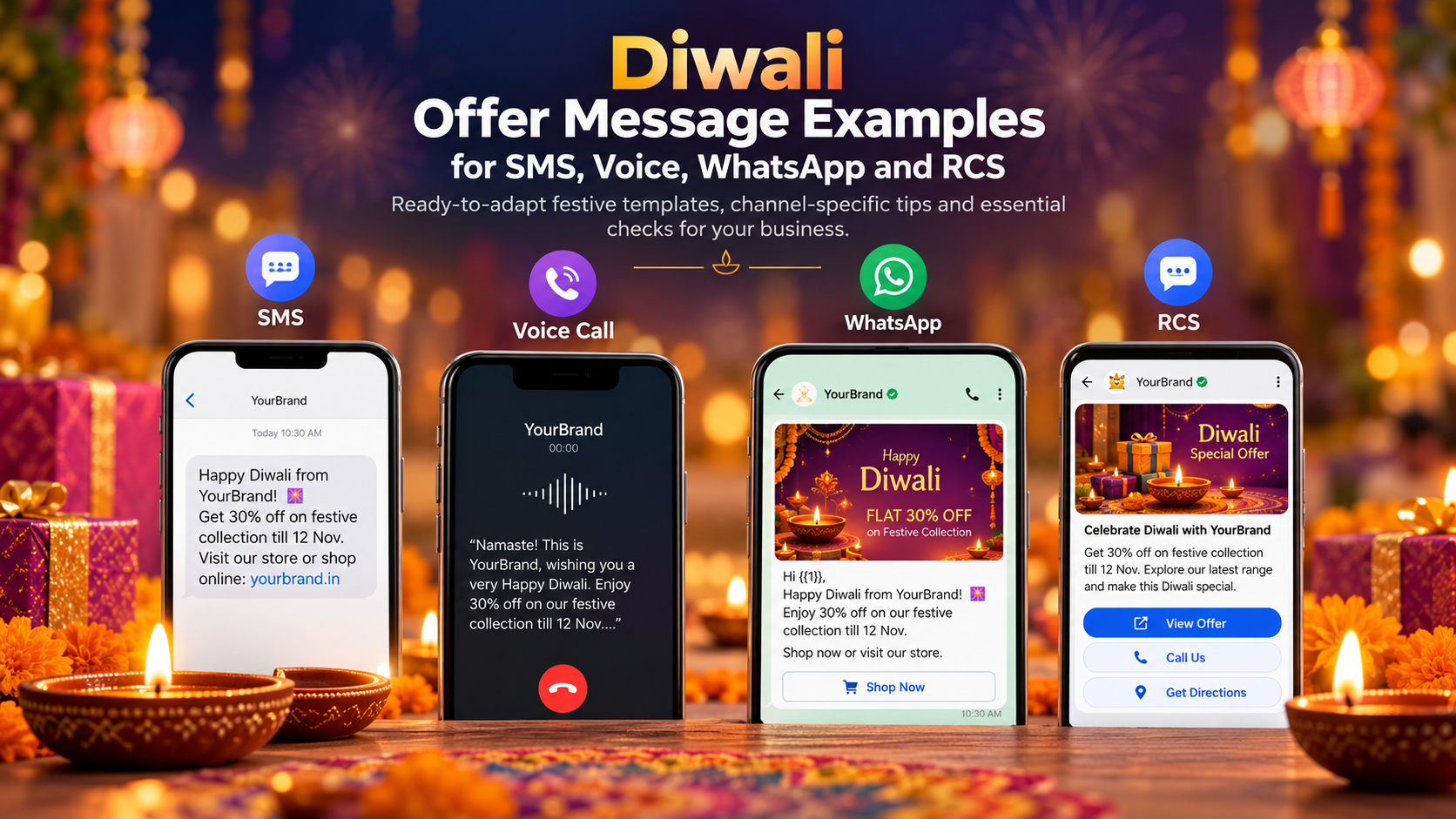
Diwali promotion | “[Brand Name] wishes you a joyful Diwali! Discover our festive offers on [Product Category]: [Link]” |
New arrivals | “New festive arrivals are here at [Brand Name]. Explore the latest [Product Category] and find your seasonal favourites: [Link]” |
Gift packages | “Make gifting special with [Brand Name]’s festive hampers starting at [Price]. View available options: [Link]” |
Store invitation | “Visit [Store Name] at [Location] for our festive collection and special offers through [Date]. Details: [Link]” |
Offer reminder | “Reminder from [Brand Name]: Our festive offer on [Product Category] ends [Date]. Review eligibility and shop: [Link]” |
Customer appreciation | “Thank you for choosing [Brand Name]. Wishing you a wonderful festive season filled with happiness and prosperity.” |
Booking promotion | “Plan your festive outing with [Business Name]. Check available dates and packages for [Event/Service]: [Link]” |
How to improve these SMS templates
A good promotional SMS should answer three questions quickly:
Who is sending the message?
What is the customer being offered or told?
What should the customer do next?
Keep the offer specific, avoid unnecessary introductory text and ensure that any stated discount, validity period, price or product availability is accurate.
Where possible, use a campaign-specific landing page instead of sending every recipient to the homepage. A dedicated page can present the advertised offer immediately and make campaign performance easier to measure.
Remember that message length, sender identification, link rules and template approval requirements can affect the final message format.
SMS vs WhatsApp for Festive Marketing: Which Should You Use?
SMS and WhatsApp can support the same seasonal business objective, but they serve different communication needs.
Factor | SMS marketing | WhatsApp marketing |
|---|---|---|
Best use | Concise announcements, alerts and offer reminders | Richer promotional experiences and conversations |
Message format | Primarily text, with supported links and other features depending on the service | Text, images, videos, catalogues and interactive features, depending on the product and message type |
Customer interaction | Usually directs customers to a website, store or contact channel | Can support two-way conversations and customer enquiries |
Campaign examples | Sale announcements, booking reminders and discount alerts | Product showcases, catalogue sharing and guided purchase conversations |
Important consideration | Indian telecom rules, registered templates and applicable consent requirements | WhatsApp's business messaging policies, applicable opt-in requirements and message-category rules |
Neither channel is automatically better for every campaign. The right choice depends on the audience, the offer, the communication format and the customer's preferences.
A practical multichannel approach
Consider a retailer launching a Diwali collection.
Stage 1: Introduce the collection through social media and the website.
Stage 2: Send a concise SMS announcing the sale to eligible recipients.
Stage 3: Use WhatsApp to share product images and answer customer questions where customers have opted in and the message is permitted.
Stage 4: Measure enquiries, purchases and revenue attributed to each channel.
This approach gives each channel a purpose and helps reduce unnecessary duplicate messages.