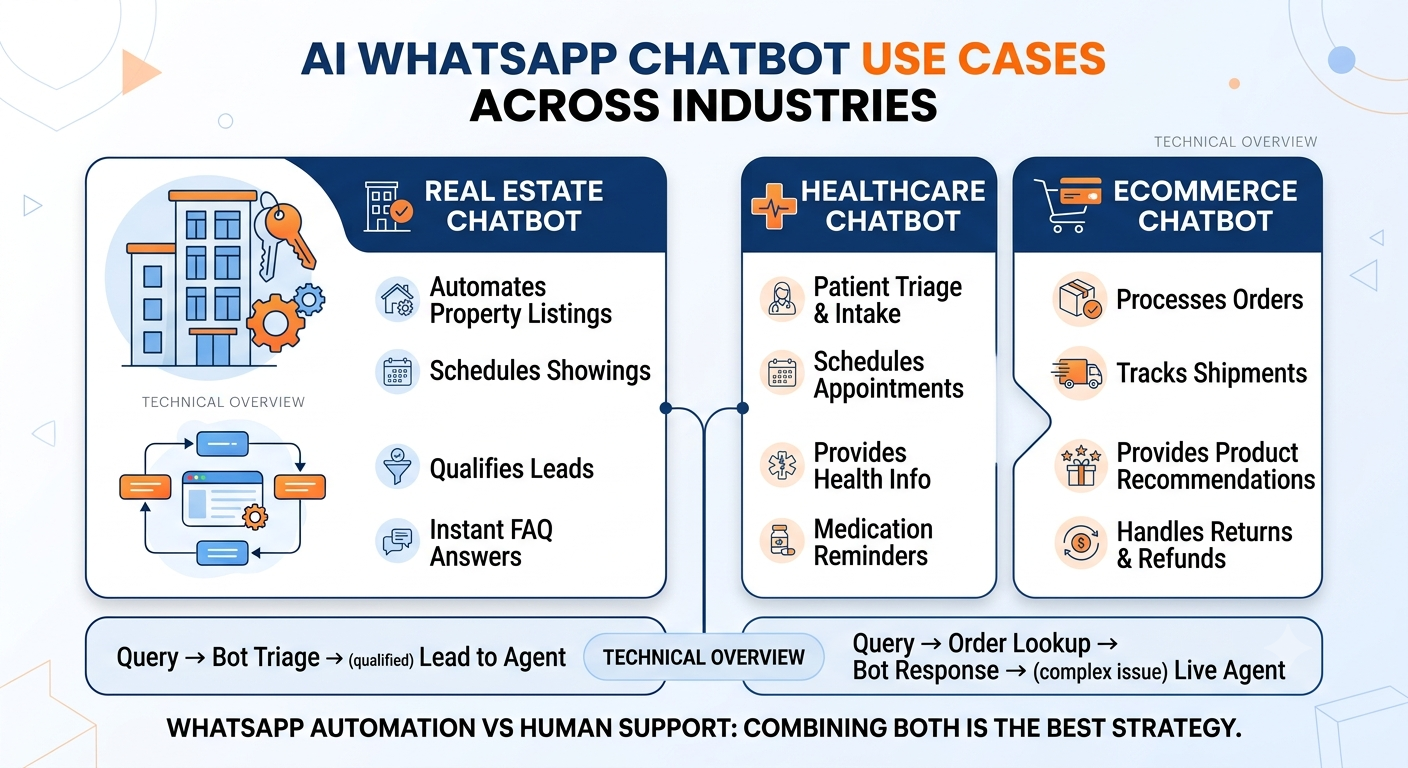
🤖 AI WhatsApp Chatbot Use Cases Across Industries: How Businesses Are Transforming Customer Communication
As customer expectations continue to rise, businesses are looking for smarter ways to deliver instant support, automate repetitive tasks, and engage customers across their preferred communication channels. WhatsApp has emerged as one of the most powerful platforms for business messaging, and AI-powered chatbots are helping organizations unlock its full potential.
An AI WhatsApp chatbot is more than just an automated messaging tool. It acts as a virtual assistant capable of answering questions, capturing leads, scheduling appointments, processing customer requests, and providing personalized assistance 24/7. These capabilities make WhatsApp chatbot use cases relevant across nearly every industry.
In this comprehensive guide, we'll explore how different sectors are using AI-powered WhatsApp chatbots to improve customer experiences, increase efficiency, and drive business growth.
What Is an AI WhatsApp Chatbot?
An AI WhatsApp chatbot is an intelligent virtual assistant integrated with the WhatsApp Business Platform. Using Artificial Intelligence (AI) and Natural Language Processing (NLP), it understands customer messages, interprets intent, and delivers accurate, contextual responses.
Unlike traditional rule-based bots, AI chatbots can:
- Understand natural conversations
- Respond instantly
- Learn from interactions
- Personalize customer experiences
- Automate repetitive tasks
- Integrate with CRM, ERP, and business applications
This enables businesses to provide seamless communication while reducing manual workloads.
Why Businesses Are Adopting AI WhatsApp Chatbots
Organizations across industries are investing in AI-powered chatbots because they help:
- Deliver 24/7 customer support
- Reduce operational costs
- Increase lead generation
- Improve customer satisfaction
- Automate business processes
- Handle thousands of conversations simultaneously
- Boost employee productivity
As digital communication becomes more important, AI chatbots provide a scalable solution for managing customer interactions efficiently.
Top WhatsApp Chatbot Use Cases Across Industries
1. E-commerce Industry
Online retailers receive thousands of customer inquiries every day. An eCommerce chatbot helps automate the entire shopping journey.
Common Use Cases
- Product recommendations
- Order tracking
- Cart abandonment recovery
- Shipping updates
- Payment confirmations
- Return and refund assistance
- Customer support
Benefits
- Higher conversion rates
- Faster customer service
- Increased repeat purchases
- Reduced support workload
2. Real Estate Industry
A chatbot for real estate simplifies property inquiries and accelerates lead qualification.
Common Use Cases
- Property recommendations
- Budget-based property search
- Site visit scheduling
- Lead qualification
- Agent assignment
- Project information
- Document sharing
Benefits
- Faster lead response
- Higher-quality inquiries
- Increased property visits
- Improved sales productivity
3. Healthcare Industry
A healthcare chatbot helps hospitals, clinics, and diagnostic centers provide faster patient support while reducing administrative tasks.
Common Use Cases
- Appointment booking
- Doctor availability
- Patient registration
- Prescription reminders
- Lab report notifications
- Vaccination reminders
- Health awareness campaigns
Benefits
- Reduced appointment no-shows
- Improved patient engagement
- Faster communication
- Better healthcare accessibility
4. Education Industry
Educational institutions use WhatsApp chatbots to support students, parents, and applicants throughout the admission process.
Common Use Cases
- Admission inquiries
- Course information
- Fee reminders
- Exam schedules
- Result notifications
- Student support
- Event announcements
Benefits
- Faster admission responses
- Better student engagement
- Reduced administrative workload
- Improved communication with parents
5. Banking and Financial Services
Banks and financial institutions use AI chatbots to enhance customer service while maintaining secure communication.
Common Use Cases
- Account assistance
- Loan inquiries
- Credit card information
- EMI reminders
- Transaction notifications
- Customer verification
- Service requests
Benefits
- Faster customer assistance
- Reduced call center volume
- Improved customer trust
- Better service efficiency
6. Travel and Hospitality
Travel companies and hotels use AI chatbots to automate bookings and improve guest experiences.
Common Use Cases
- Hotel reservations
- Flight inquiries
- Booking confirmations
- Travel updates
- Check-in assistance
- Cancellation requests
- Customer support
Benefits
- Faster bookings
- Better customer satisfaction
- Reduced manual operations
- Improved traveler communication
7. Retail Businesses
Retail brands leverage WhatsApp chatbots to engage customers and increase sales.
Common Use Cases
- Promotional campaigns
- Loyalty program updates
- Product availability
- Store locator assistance
- Personalized offers
- Customer feedback collection
Benefits
- Higher customer engagement
- Increased repeat business
- Better promotional performance
- Stronger customer relationships
8. Logistics and Courier Services
Logistics companies use AI chatbots to keep customers informed throughout the delivery process.
Common Use Cases
- Shipment tracking
- Delivery updates
- Pickup scheduling
- Delivery confirmations
- Customer support
Benefits
- Fewer customer inquiries
- Better delivery transparency
- Improved customer satisfaction
9. Insurance Companies
Insurance providers automate policy-related communication using WhatsApp chatbots.
Common Use Cases
- Policy renewal reminders
- Claim status updates
- Premium payment notifications
- Policy information
- Customer assistance
Benefits
- Improved policy retention
- Faster claims communication
- Better customer experience
10. Digital Marketing Agencies
Marketing agencies use AI chatbots to generate and nurture leads.
Common Use Cases
- Lead qualification
- Service recommendations
- Campaign inquiries
- Demo bookings
- Proposal requests
- Client onboarding
Benefits
- More qualified leads
- Faster response times
- Increased conversion rates
- Better client communication
Common Features Used Across All Industries
Regardless of the industry, most AI WhatsApp chatbots include:
- 24/7 automated customer support
- AI-powered conversations
- Frequently Asked Questions (FAQs)
- Lead capture forms
- Appointment scheduling
- CRM integration
- Payment gateway integration
- Automated follow-ups
- Live agent handover
- Analytics and reporting
These features help businesses improve efficiency while delivering a consistent customer experience.
Benefits of AI WhatsApp Chatbots Across Industries
Organizations implementing AI-powered WhatsApp chatbots experience several advantages:
Faster Customer Responses
Customers receive answers within seconds, improving satisfaction and reducing waiting times.
Increased Operational Efficiency
Automation reduces repetitive tasks and allows employees to focus on higher-value work.
Lower Support Costs
Chatbots can handle thousands of conversations simultaneously, reducing the need for large support teams.
Improved Lead Generation
AI chatbots capture, qualify, and nurture leads automatically.
Better Customer Engagement
Personalized conversations create stronger customer relationships and increase retention.
Business Scalability
Chatbots easily manage growing customer interactions without increasing operational costs.
Best Practices for Successful Chatbot Implementation
To maximize results:
- Clearly define business objectives.
- Design simple and intuitive conversation flows.
- Integrate the chatbot with CRM and business systems.
- Regularly update chatbot knowledge.
- Offer seamless live-agent support when needed.
- Monitor chatbot analytics and continuously optimize performance.
Future of AI WhatsApp Chatbots
Artificial Intelligence continues to transform customer communication.
Future advancements will include:
- Voice-enabled WhatsApp assistants
- Predictive customer support
- AI-powered multilingual conversations
- Hyper-personalized recommendations
- Advanced sentiment analysis
- Intelligent workflow automation
Businesses that adopt AI-powered messaging today will be better positioned to meet evolving customer expectations.