
Election Campaign Marketing in Madhya Pradesh
Campaign communication for Madhya Pradesh's assembly and Lok Sabha seats, its mayor and municipal council elections and its district, janpad and gram panchayat polls, across long distances and many villages.
What is Election Marketing in Madhya Pradesh?
For candidates in Madhya Pradesh, the message only works if it reaches every voter on the list.
Who is this for?
Designed for political parties, sitting MLAs and MPs, candidates in local body, cooperative and professional body elections, and first-time contenders who need their message to reach every voter.
How Campaigns in Madhya Pradesh Work with Nexcomm
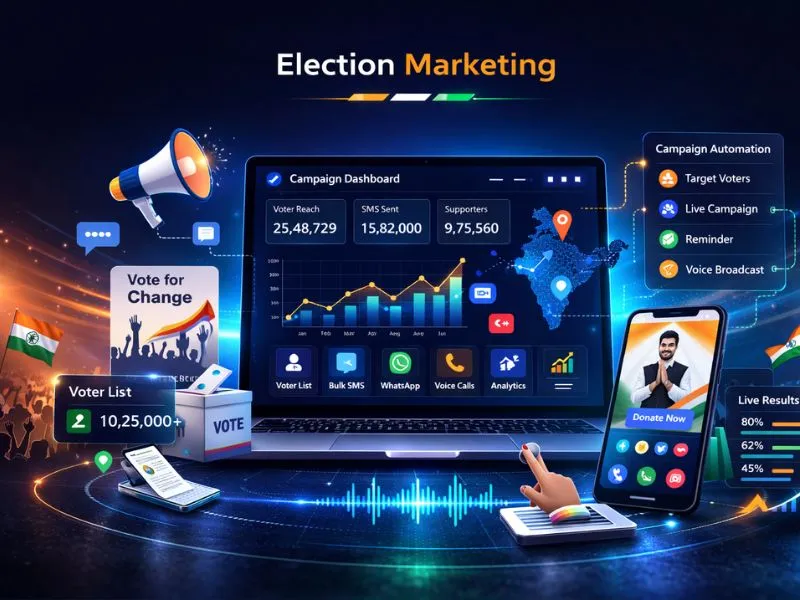
Election campaign marketing in Madhya Pradesh combines recorded calls, SMS, WhatsApp and online ads, built on voter lists sorted by booth and ward. Madhya Pradesh is a large state with long distances between its towns, and its elections reflect that. Mayors and corporators are chosen in the cities, municipal councils in the smaller towns, and the three tiers of district, janpad and gram panchayats reach almost every village. Assembly and Lok Sabha seats combine all of these in one constituency, and a candidate may spend a full day driving from one end of the seat to the other.
A phone campaign shortens those distances. Nexcomm sorts the voter list by booth, ward and village and then matches channel to place. Recorded voice calls and SMS carry the candidate's voice into villages where data is thin. In the cities, WhatsApp and social media serve voters who are online. For a first-time contender in Madhya Pradesh, the team suggests a plan after hearing about the constituency, the timeline and the voters to be reached.
Madhya Pradesh is several regions in one state. Malwa around Indore and Ujjain, the Gwalior and Chambal belt, Bundelkhand, Mahakoshal around Jabalpur and the tribal districts of Jhabua and Mandla each keep their own rhythm of markets, festivals and travel. The Narmada parikrama, the Simhastha at Ujjain and the village fairs held after harvest bring crowds on set dates, and a message planned around them reaches people who are gathered or on the move. A candidate who keeps a separate list for each region can send each its own message and see how each list responded.
Madhya Pradesh's towns have election rhythms of their own. Municipal corporations in Bhopal and Indore, councils in Sagar, Rewa and Satna and nagar panchayats in smaller towns each elect on their own timetables, while panchayat polls follow a three-tier schedule. A campaign that keeps a calendar for each tier can avoid overlapping messages and give each list the right content. Nexcomm sorts the voter list by ward, booth and village, plans the schedule with the candidate and sends by SMS, recorded call and WhatsApp.
Nexcomm works with candidates and campaign teams across India from its office in Pune, and the team can be reached by phone or email.
Campaigns We Support in Madhya Pradesh
Mayor and corporator contests in the cities
City candidates reach ward households with SMS, recorded calls and WhatsApp, using a list sorted by ward and booth.
Municipal council and nagar panchayat seats
Candidates in smaller towns use SMS and recorded calls to reach every household, since a town's electorate is small enough to cover completely.
Three-tier panchayat elections
District, janpad and gram panchayat candidates rely on recorded voice calls and SMS in villages, which work on any handset.
Seats that need a day's drive
Assembly and Lok Sabha candidates use the phone to reach villages their team cannot visit in time, with messages planned booth by booth.
Region-by-region lists
A candidate keeps separate lists for Malwa, Gwalior and Chambal, Bundelkhand and Mahakoshal booths, sends each its own message and recorded call, and reads each region's delivery report on its own.
Town councils with their own calendar
Candidates in municipal councils and nagar panchayats keep a separate schedule and list for each town, so messages follow the local timetable.
Frequently Asked Questions
Find Services Available Near You
Explore our service availability across major cities, states, and election types.
Lok Sabha (MP) Elections
Parliamentary constituency campaigns
Vidhan Sabha (MLA) Elections
Assembly constituency campaigns
Teachers' Constituency MLC Elections
Reaching registered teacher voters
Graduates' Constituency MLC Elections
Reaching registered graduate voters
Municipal Corporation (Corporator) Elections
Ward-level civic campaigns
Mayor Elections
Mayoral election campaigns
Municipal Council & Nagar Panchayat Elections
Town ward campaigns
Zilla Parishad & Panchayat Samiti Elections
District and block campaigns
Gram Panchayat & Sarpanch Elections
Village-level campaigns
Cooperative Sugar Factory Elections
Reaching member farmers
Cooperative Bank & Society Elections
Reaching members and shareholders
APMC (Market Committee) Elections
Farmer and trader constituencies
Bar Council & Bar Association Elections
Campaigns among advocates
CA Institute (ICAI) Elections
Campaigns among chartered accountants
Medical Council & Association Elections
Campaigns among doctors
University Senate & Student Elections
Campus and senate campaigns
Plan Your Campaign in Madhya Pradesh
Reach every voter with SMS, voice calls, WhatsApp, social media and online ads, run by one team.
Discuss Your Campaign