By Rohit Jadhav, Nexcomm. Reviewed 11 November 2026.
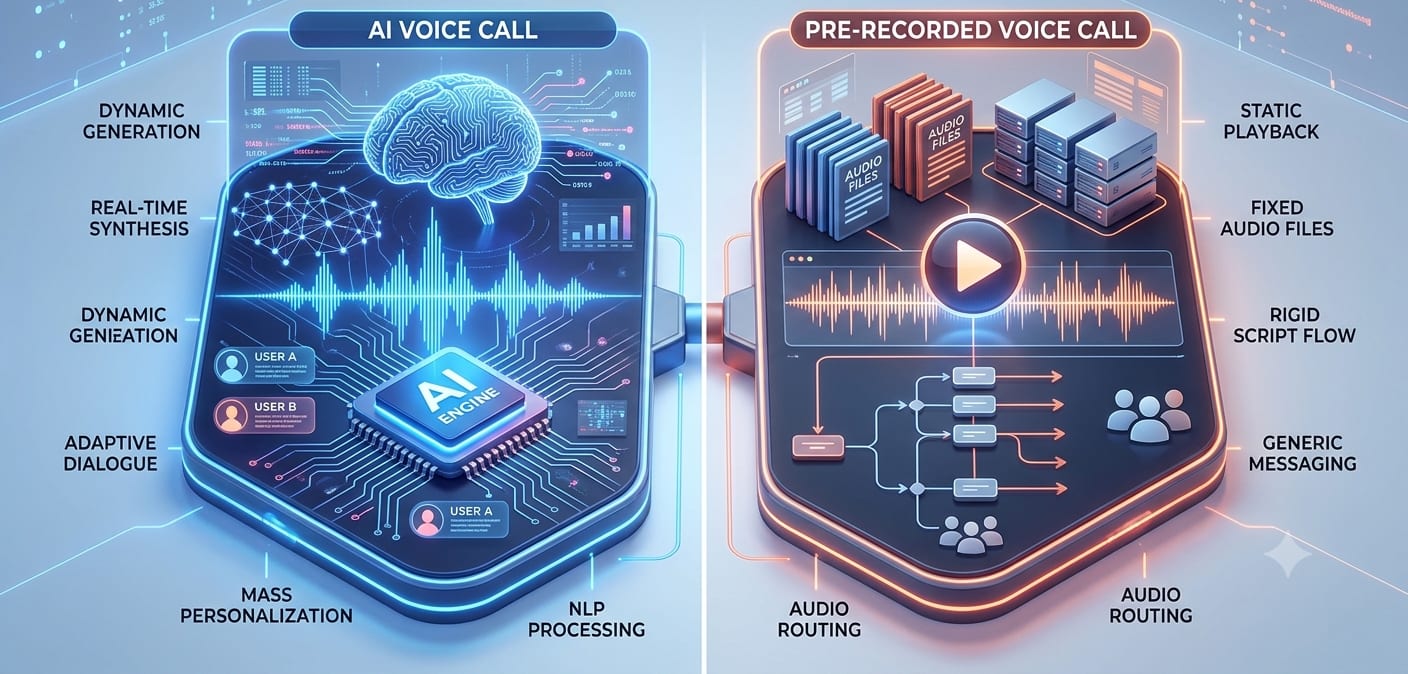
A pre-recorded voice call plays the same message to everyone. An AI voice call is meant to hold a short conversation: it speaks, listens to the answer and responds. The second is more flexible and also harder to get right. This guide explains the difference, where each fits and what to check before you try AI voice. For the basics, see what a bulk voice call service is. We offer bulk voice calls. This post describes the category in general and makes no claim about any particular product.
Quick answer
Use a pre-recorded call when you only need to deliver a short message or collect a keypad response. Consider an AI voice call when people may give free-form answers, such as confirming an appointment in their own words or asking a question. Test any AI voice product on real calls in your languages before you rely on it.
Pre-recorded vs AI voice
| Pre-recorded call | AI voice call | |
|---|---|---|
| What it does | Plays a fixed message; may take a keypad press | Speaks, listens to speech and responds |
| Set-up | Record a message, upload numbers | Design the conversation, train or configure it, test it |
| Responses | Keypad choices such as "press 1" | Spoken answers, which can be varied and unclear |
| Languages and accents | One recording per language | Depends on how well speech recognition handles each language and accent |
| Predictability | High: every person hears the same words | Lower: the call can go in different directions |
| Cost | Usually lower | Usually higher, because more processing is involved |
| Best for | Reminders, announcements, simple surveys | Confirmations, qualification calls, simple questions |
When pre-recorded is the better choice
- The message is a one-way notice.
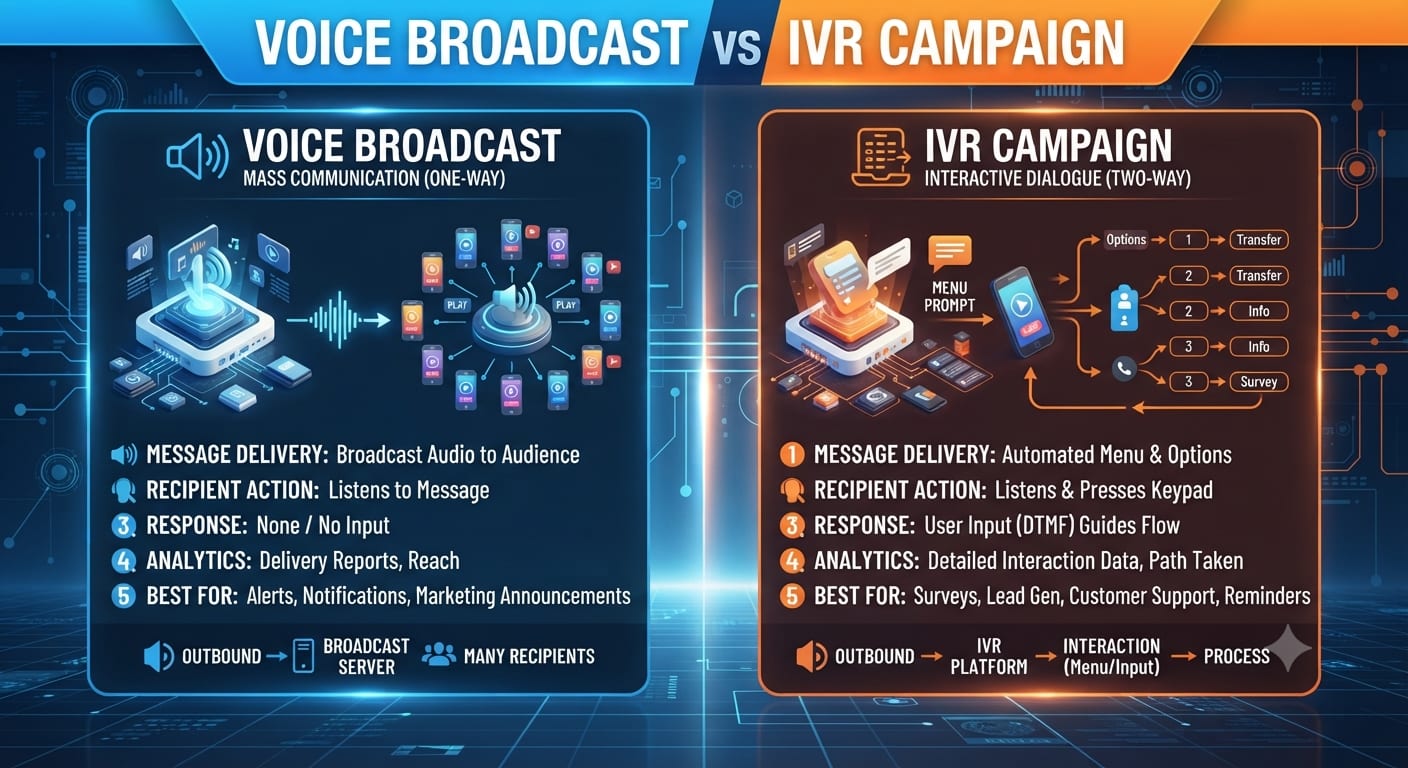
- A keypad answer is enough. See press 1 voice campaigns.
- You need exactly the same wording for every person, for compliance or clarity.
When AI voice may help
- You want people to answer in their own words, for example to give a preferred time.
- You have many repeat questions with short answers.
- You can hand the call to a person when the AI cannot cope.
What to check before you try AI voice
- Language support. Ask which languages and accents it handles, and test your own.
- Handover. What happens when it does not understand, or the person asks for a human?
- Disclosure. People should know they are speaking to an automated system. Keep wording clear.
- Rules. Automated calls fall under TRAI's rules for such calls. Ask the provider how AI calls are classified and which numbers they use. See TRAI rules for bulk voice calls.
- Reports. Can you listen to or read what was said, and see outcomes per call? Compare with voice campaign reports.
- Data. Where are recordings and transcripts stored, and for how long?
A hypothetical test
A clinic wants to confirm next-day appointments. It runs 100 calls with a pre-recorded "press 1 to confirm" and 100 with an AI voice call that asks "Will you be able to come tomorrow at 10?" It compares how many confirmed, how many hung up in the first ten seconds, and how many calls needed a person. The simpler flow may win on cost, while the AI call may win on answers it could not otherwise collect.
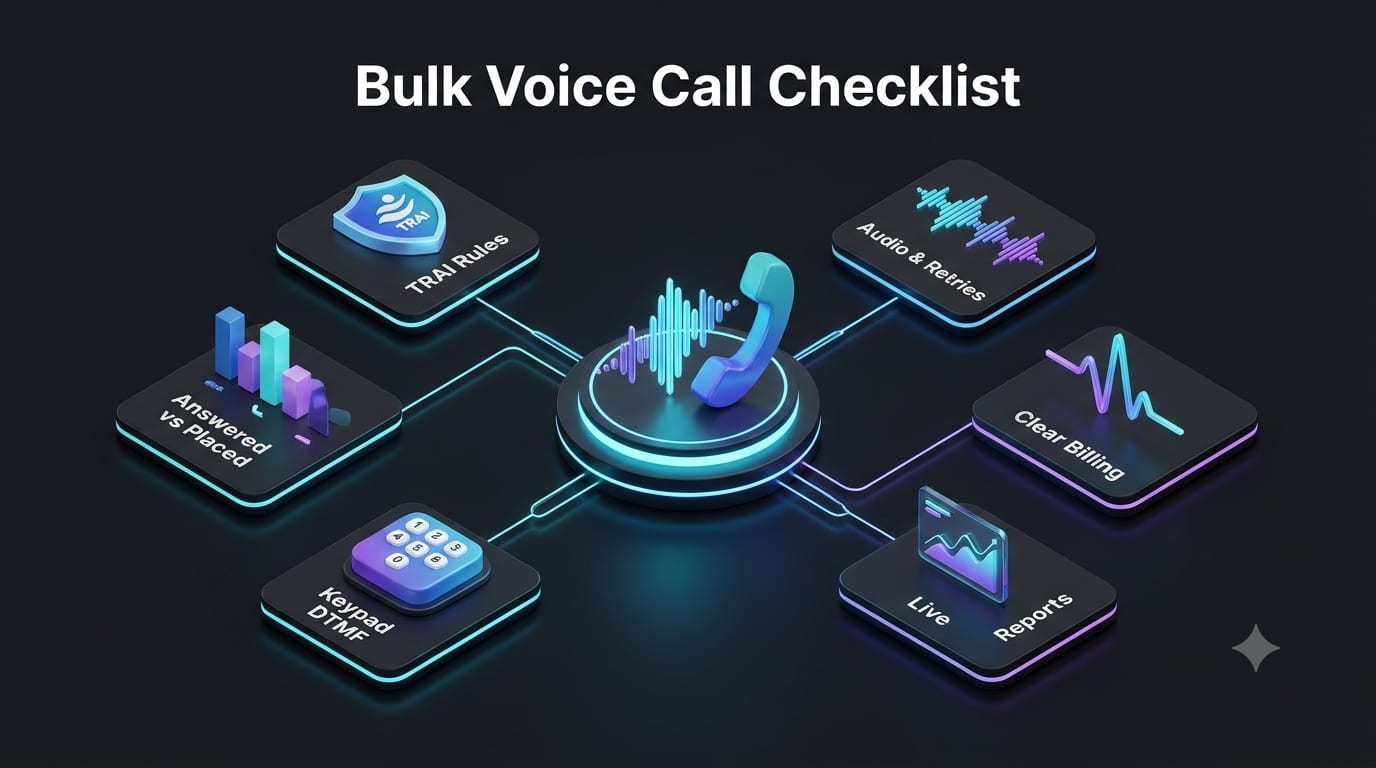
Before either, get the script right. See how to write a bulk voice call script, and use our provider checklist to compare. More guides: Voice and IVR guides.
Frequently asked questions
Is an AI voice call a robo call?
It is an automated call. Ask your provider and read the TRAI rules for how such calls are treated.
Can AI voice speak Indian languages?
Some products do, with varying accuracy by language and accent. Test it with your own audience.
Is AI voice always better?
No. For simple notices a pre-recorded call is cheaper and more predictable.
Can I start with pre-recorded?
Yes. Start simple, measure, then add AI where answers matter.
Sources checked
- TRAI, TCCCPR 2018, trai.gov.in.
- Nexcomm's voice guides linked above.