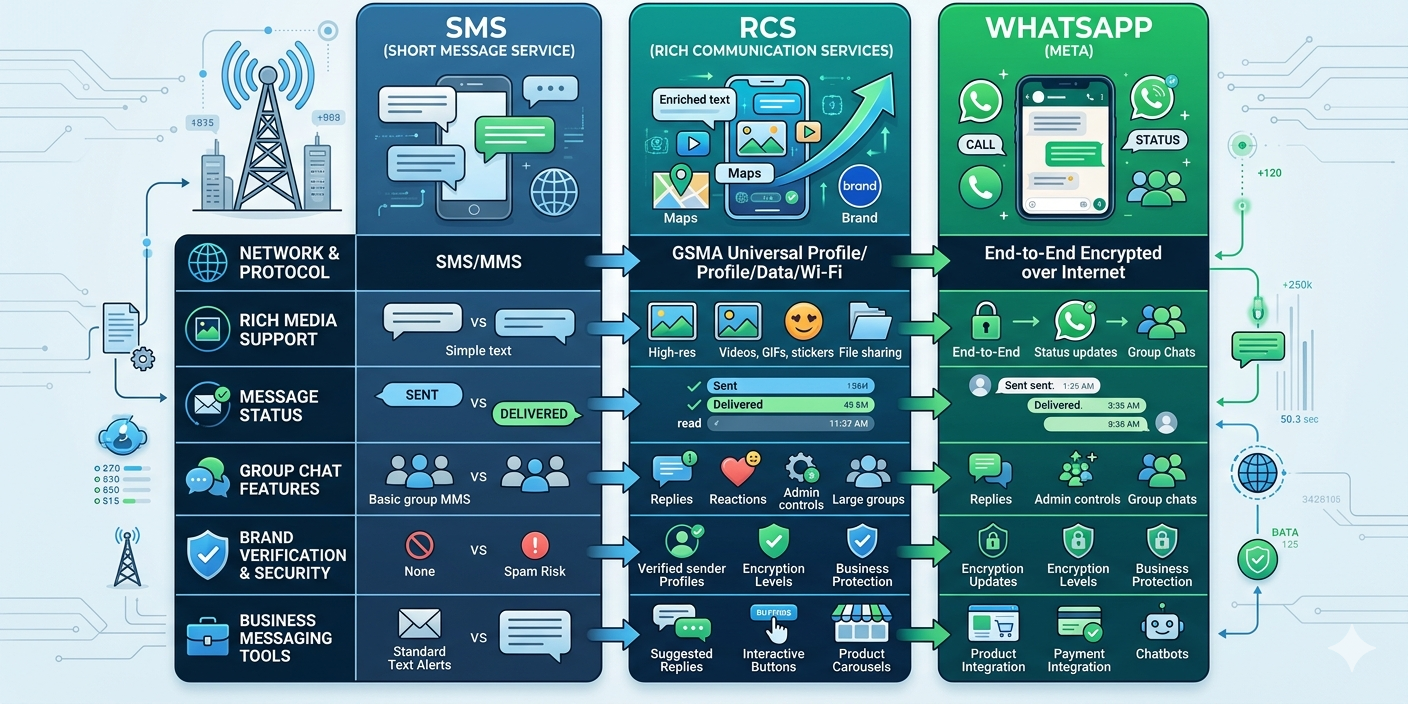
RCS Messaging vs SMS vs WhatsApp: Complete Comparison
Business communication has evolved dramatically over the last decade. Traditional SMS marketing is no longer the only option available for customer engagement. Businesses now use multiple communication channels including WhatsApp Business API and RCS messaging to create faster, smarter, and more interactive customer experiences.
But many businesses still ask an important question:
Which communication channel is better — RCS, SMS, or WhatsApp?
The answer depends on:
- Business goals
- Customer audience
- Campaign type
- Budget
- Engagement requirements
In this detailed guide, we’ll compare RCS vs SMS vs WhatsApp across features, pricing, reach, automation capabilities, customer engagement, and business use cases.
This blog will help businesses choose the right communication platform for marketing, notifications, support, and customer engagement.
Understanding the Three Messaging Channels
Before comparing them, let’s briefly understand how each platform works.
What is SMS?
SMS (Short Message Service) is the traditional text messaging technology available on all mobile phones.
Businesses use SMS for:
- OTP verification
- Transaction alerts
- Promotional campaigns
- Delivery notifications
SMS remains one of the most widely used communication channels because it works without internet access.
What is WhatsApp Business API?
WhatsApp Business API is a business communication solution that allows companies to send messages through WhatsApp at scale.
It supports:
- Customer support
- Automated replies
- Media sharing
- AI chatbots
- Interactive messaging
Businesses use WhatsApp for conversational communication and customer engagement.
What is RCS Messaging?
RCS (Rich Communication Services) is considered the next generation of SMS.
Unlike traditional SMS, RCS supports:
- Rich media
- Buttons
- Branding
- Carousels
- Interactive communication
RCS combines the simplicity of SMS with app-like messaging experiences.
RCS vs SMS vs WhatsApp: Feature Comparison
| Feature | SMS | RCS Messaging | |
|---|---|---|---|
| Internet Required | No | Yes | Yes |
| Rich Media Support | No | Yes | Yes |
| Images & Videos | Limited | Yes | Yes |
| Interactive Buttons | No | Yes | Yes |
| Read Receipts | No | Yes | Yes |
| Verified Business Profile | No | Yes | Yes |
| Works on Feature Phones | Yes | No | Limited |
| Open Rate | High | Very High | Very High |
| API Integration | Yes | Yes | Yes |
| Two-Way Communication | Limited | Excellent | Excellent |
This comparison highlights why businesses are increasingly evaluating RCS vs SMS vs WhatsApp for customer communication strategies.
SMS: Advantages & Limitations
Advantages of SMS
1. Universal Reach
SMS works on:
- Smartphones
- Feature phones
- Basic mobile devices
No internet connection is required.
2. High Delivery Reliability
SMS delivery is supported by telecom infrastructure directly.
3. Ideal for OTP & Alerts
Banks and fintech companies rely heavily on SMS for:
- OTP verification
- Transaction alerts
- Security notifications
Limitations of SMS
Despite its reliability, SMS has limitations.
No Rich Media
SMS supports only plain text.
Limited Engagement
SMS lacks interactive features like buttons or carousels.
Minimal Branding
Businesses cannot create branded messaging experiences.
WhatsApp: Advantages & Limitations
Advantages of WhatsApp Business API
1. Conversational Communication
WhatsApp enables two-way customer interaction.
2. Rich Media Messaging
Businesses can send:
- Images
- PDFs
- Videos
- Product catalogs
3. AI Chatbot Integration
WhatsApp supports automation through AI-powered chatbots.
4. Customer Support Automation
Businesses use WhatsApp for:
- Live chat
- Customer support
- Automated workflows
Limitations of WhatsApp
Requires App Installation
Customers must have WhatsApp installed.
Meta Approval Process
Businesses must complete verification and template approval.
Internet Dependency
WhatsApp requires internet connectivity.
RCS Messaging: Advantages & Limitations
Advantages of RCS Messaging
1. Interactive Messaging Experience
RCS supports:
- Buttons
- Rich cards
- Product carousels
- Suggested replies
2. Verified Branding
Businesses can display:
- Brand logo
- Verified sender name
This improves customer trust.
3. Native Messaging Experience
Unlike WhatsApp, RCS works inside the default messaging app.
4. Better Customer Engagement
Interactive features improve response and conversion rates.
Limitations of RCS Messaging
Limited iPhone Support
RCS adoption is currently stronger on Android devices.
Internet Required
RCS works through mobile data or Wi-Fi.
Carrier & Device Dependency
Some devices and operators may not fully support RCS yet.
RCS Features vs SMS
When comparing RCS features vs SMS, the biggest differences are:
| Capability | SMS | RCS |
|---|---|---|
| Rich Media | No | Yes |
| Interactive Buttons | No | Yes |
| Branding | No | Yes |
| Analytics | Basic | Advanced |
| Read Receipts | No | Yes |
| Typing Indicators | No | Yes |
RCS essentially upgrades SMS into a modern communication platform.
Business Messaging Comparison: Which Channel is Best?
The best platform depends on business objectives.
Best for OTP & Alerts → SMS
SMS remains ideal for:
- OTP authentication
- Banking alerts
- Emergency communication
because of universal reach.
Best for Customer Support → WhatsApp
WhatsApp is highly effective for:
- Customer support
- AI chatbots
- Conversational commerce
Best for Interactive Marketing → RCS
RCS is excellent for:
- Rich campaigns
- Product showcases
- Interactive customer engagement
Industries Using SMS, WhatsApp & RCS
Banking & Finance
- SMS for OTPs
- WhatsApp for support
- RCS for interactive notifications
E-Commerce
- SMS for order alerts
- WhatsApp for support
- RCS for product marketing
Healthcare
- SMS reminders
- WhatsApp consultations
- RCS appointment engagement
Education
- SMS notifications
- WhatsApp communication groups
- RCS admission campaigns
Cost Comparison: SMS vs WhatsApp vs RCS
Pricing varies based on:
- Message volume
- Media usage
- API integrations
- Telecom charges
Generally:
| Platform | Approx Cost Level |
|---|---|
| SMS | Low |
| WhatsApp API | Medium |
| RCS Messaging | Medium to High |
However, higher engagement often improves ROI.
API & Automation Capabilities
All three channels support APIs.
SMS API
Used for:
- OTP systems
- Alert automation
WhatsApp API
Used for:
- Chatbots
- Customer support
- Automation workflows
RCS API
Used for:
- Rich campaigns
- Interactive messaging
- Conversational marketing
Future of Business Messaging in India
The future of business communication will likely combine:
- SMS
- RCS Messaging
- AI chatbots
Businesses are increasingly adopting omnichannel communication strategies to improve customer engagement.
Which Messaging Channel Should Your Business Choose?
Here’s a simplified recommendation:
| Business Goal | Best Platform |
|---|---|
| OTP & Alerts | SMS |
| Customer Support | |
| Interactive Marketing | RCS |
| Rural Reach | SMS |
| Conversational Commerce | |
| Rich Customer Experience | RCS |
The smartest businesses combine all three platforms strategically.
Why Omnichannel Communication Matters
Modern customers expect communication across multiple channels.
Businesses that combine:
- SMS alerts
- WhatsApp support
- RCS engagement
can create a seamless customer experience.
Best Practices for Business Messaging
To improve campaign performance:
- Personalize communication
- Use strong CTAs
- Avoid spam messaging
- Track engagement metrics
- Follow compliance guidelines