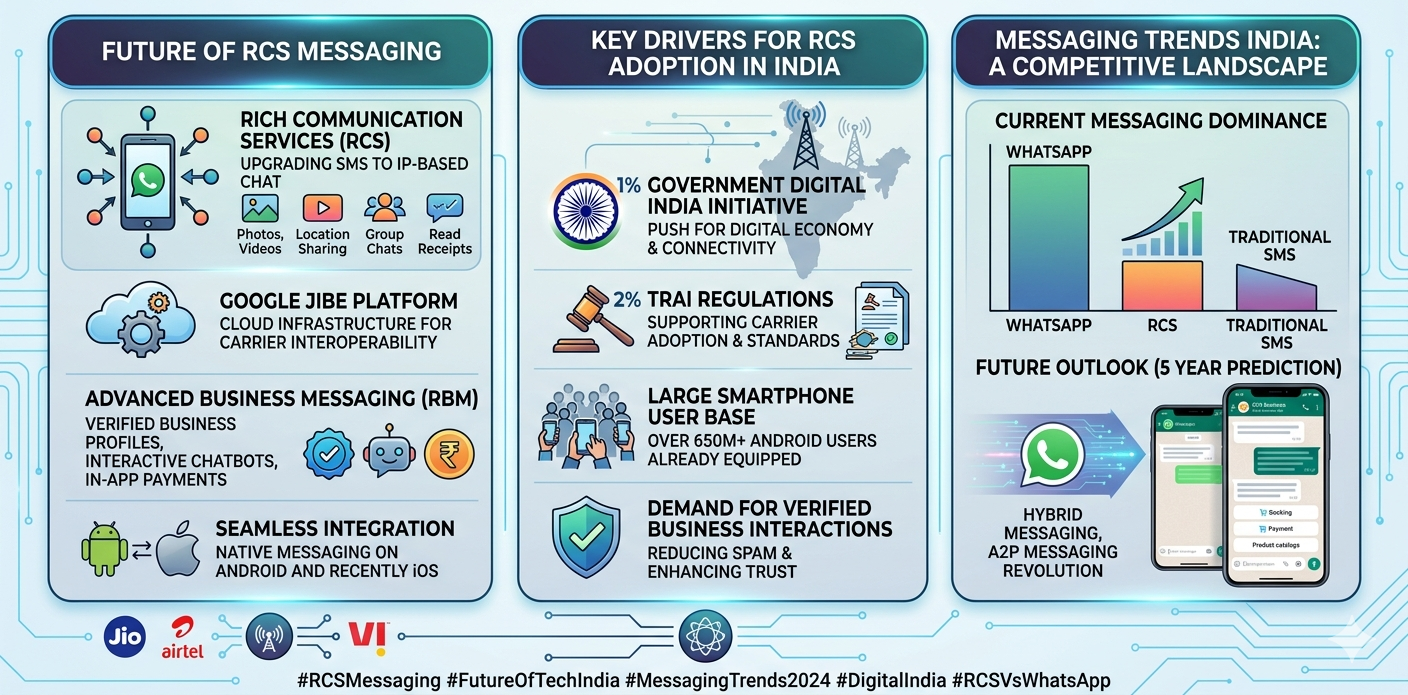
🚀 Future of RCS Messaging in India: Is It the Next WhatsApp?
The way businesses communicate with customers is changing rapidly. Over the last decade, messaging apps have transformed customer engagement, making conversations faster, richer, and more interactive. While SMS remains a trusted communication channel, modern consumers increasingly expect visual, personalized, and action-oriented messaging experiences.
This shift has fueled the growth of RCS (Rich Communication Services), a next-generation messaging technology designed to bring app-like functionality directly into native mobile messaging applications.
As smartphone penetration rises and digital engagement becomes a business priority, many industry experts are asking an important question:
Is RCS Messaging the Next WhatsApp?
The answer is not simple. While RCS may not replace WhatsApp entirely, it has the potential to redefine how businesses communicate with customers in India.
In this article, we'll explore the future of RCS messaging, current RCS adoption in India, emerging messaging trends, and what businesses should expect over the next few years.
Understanding RCS Messaging
Before discussing the future, it's important to understand what RCS actually is.
RCS (Rich Communication Services) is an upgraded messaging protocol that enhances traditional SMS with features such as:
📷 Images and Videos
🎯 Interactive Buttons
🛒 Product Carousels
📍 Maps and Locations
✅ Verified Business Profiles
📊 Read Receipts and Analytics
Instead of sending plain text messages, businesses can create interactive customer experiences within the native messaging app.
Think of RCS as the bridge between SMS and modern messaging applications.
Why Messaging Is Becoming the New Customer Experience Channel
Customer behavior has changed significantly.
Consumers now prefer:
- Instant communication
- Self-service options
- Visual experiences
- Personalized interactions
- Mobile-first engagement
Traditional channels such as email and phone calls are often slower and less convenient.
Messaging has become the preferred communication method because it combines speed, convenience, and accessibility.
This trend is creating new opportunities for RCS adoption.
The Current State of RCS Adoption in India 🇮🇳
India is one of the world's largest mobile-first markets.
Several factors make the country highly suitable for RCS growth:
Massive Smartphone User Base
India has hundreds of millions of smartphone users who increasingly rely on mobile messaging for communication.
Growing Digital Economy
Businesses are investing heavily in:
- Digital marketing
- Customer engagement
- Conversational commerce
- Mobile experiences
Demand for Better Business Communication
Customers expect brands to provide richer interactions than traditional SMS.
This creates a favorable environment for RCS adoption in India.
Why Businesses Are Interested in RCS
Organizations across industries are exploring RCS because it offers capabilities that traditional SMS cannot provide.
Better Customer Engagement
Interactive messages naturally generate higher engagement.
Rich Visual Experiences
Images and videos improve customer attention and retention.
Verified Branding
Businesses can display:
🏢 Company Name
🎨 Brand Logo
✅ Verification Badge
This builds trust and reduces spam concerns.
Measurable Campaign Performance
Unlike SMS, RCS provides analytics such as:
- Delivery reports
- Read receipts
- Click tracking
- User interactions
These insights help businesses optimize communication strategies.
Can RCS Compete with WhatsApp?
This is perhaps the most frequently asked question.
What Makes WhatsApp Strong?
WhatsApp already has:
- Massive user adoption
- Familiar interface
- Multimedia messaging
- Business APIs
- Chatbots
- End-to-end encryption
Its network effect is extremely powerful.
What Makes RCS Different?
Unlike WhatsApp, RCS does not require users to install a separate application.
Messages appear directly within the native messaging app.
Advantages include:
✅ No app download required
✅ Native mobile experience
✅ Carrier-supported ecosystem
✅ Verified business communication
✅ Broad customer reach
For businesses, this lower barrier to entry can be very attractive.
RCS vs WhatsApp: Future Outlook
| Feature | RCS | |
|---|---|---|
| Native Messaging App | ✅ | ❌ |
| App Installation Required | ❌ | ✅ |
| Rich Media Support | ✅ | ✅ |
| Interactive Messaging | ✅ | ✅ |
| Business APIs | ✅ | ✅ |
| Verified Business Profiles | ✅ | ✅ |
| Customer Reach | Growing | Massive |
Rather than replacing WhatsApp, RCS is likely to become another critical channel in an omnichannel communication strategy.
Industries That Could Drive RCS Growth
Several industries are expected to accelerate RCS adoption.
🛍️ Ecommerce
Potential applications include:
- Product launches
- Cart recovery
- Order tracking
- Personalized offers
🏦 Banking & Financial Services
Banks can leverage RCS for:
- Transaction alerts
- Fraud notifications
- Customer education
- Loan promotions
🏥 Healthcare
Healthcare providers can use RCS for:
- Appointment reminders
- Patient engagement
- Wellness campaigns
🎓 Education
Educational institutions can improve communication through:
- Admission updates
- Student notifications
- Event announcements
🏠 Real Estate
Real estate companies can showcase properties using:
- Rich image galleries
- Virtual tours
- Appointment scheduling
Emerging Messaging Trends in India
The future of customer communication is being shaped by several important trends.
Conversational Commerce
Customers increasingly prefer buying products through conversations rather than websites.
AI-Powered Messaging
Artificial intelligence is making customer interactions more personalized and efficient.
Omnichannel Communication
Businesses are integrating:
- SMS
- RCS
- Voice Calls
to create seamless customer journeys.
Interactive Marketing
Static advertising is giving way to interactive customer experiences.
RCS fits perfectly within this trend.
Challenges Facing RCS Adoption
Despite its potential, RCS still faces several challenges.
Device Compatibility
Not all devices currently support RCS functionality.
User Awareness
Many consumers are unfamiliar with RCS technology.
Business Education
Companies often understand SMS and WhatsApp but are less familiar with RCS opportunities.
Ecosystem Development
Broader industry participation is necessary to accelerate adoption.
However, these challenges are gradually decreasing as the technology matures.
What Will RCS Look Like in 2030?
Looking ahead, the future of RCS messaging is likely to include:
🤖 AI-powered conversations
🛒 Conversational commerce experiences
🎯 Hyper-personalized messaging
📊 Advanced customer analytics
🌐 Omnichannel customer journeys
📱 Richer mobile interactions
Businesses will increasingly use RCS as part of a broader customer engagement strategy rather than as a standalone channel.
Why Businesses Should Prepare Now
Many organizations wait until technologies become mainstream before adopting them.
However, early adopters often gain competitive advantages such as:
- Stronger customer engagement
- Better campaign performance
- Improved customer experiences
- Higher brand visibility
As messaging trends in India continue evolving, businesses that begin experimenting with RCS today will be better positioned for future growth.