For the Uttarakhand election 2027 campaign, plan SMS and recorded voice calls in Hindi across 70 constituencies in hills and plains. Expect patchy coverage in remote hill areas, so keep messages short, allow time for delivery, and register your sender, approve scripts and stop before the 48-hour silence period. WhatsApp's business platform is not open to political campaigns.
By Rohit Jadhav. Last reviewed 25 October 2026. This is operational guidance, not legal advice. Rules change, so confirm the current requirements for your election.
Uttarakhand has 70 assembly constituencies spread across mountain districts, foothills and the plains. That geography is the main thing a Uttarakhand election 2027 campaign has to plan for. This single guide covers the three channels people ask about, SMS, voice calls and WhatsApp, and says what each can and cannot do in a hill state. It is part of our series on election campaign messaging rules. For help with the sending side, see our election campaign services. More guides are under Election Campaigns.
How does geography affect campaign messaging in Uttarakhand?
Hill constituencies have scattered villages, long travel times between settlements and uneven mobile coverage. Plains constituencies near the larger towns look more like constituencies elsewhere. A single plan will not fit both.
For hill areas, plan for delay. A message sent to a phone in a coverage gap may arrive hours later, when the voter is back in range. That makes timing promises risky: do not announce a meeting "tomorrow at 10" by SMS the evening before and expect it to be read. Send earlier, repeat once, and rely on workers to call. Our guide to booth-level voter outreach shows how to give each booth an owner who can follow up by phone or in person.
Build the contact file in levels: state, district, assembly constituency and local campaign team. An announcement for Dehradun should not reach Pithoragarh, and a Haridwar event is different from a Nainital one. Campaigns usually plan separately for districts such as Dehradun, Haridwar, Nainital, Almora, Pauri Garhwal, Tehri Garhwal, Chamoli and Pithoragarh. See our guide to the 2027 state assembly elections for the seat count and timeline, and the Election Commission for the official schedule.
Which language and script should Uttarakhand campaign messages use?
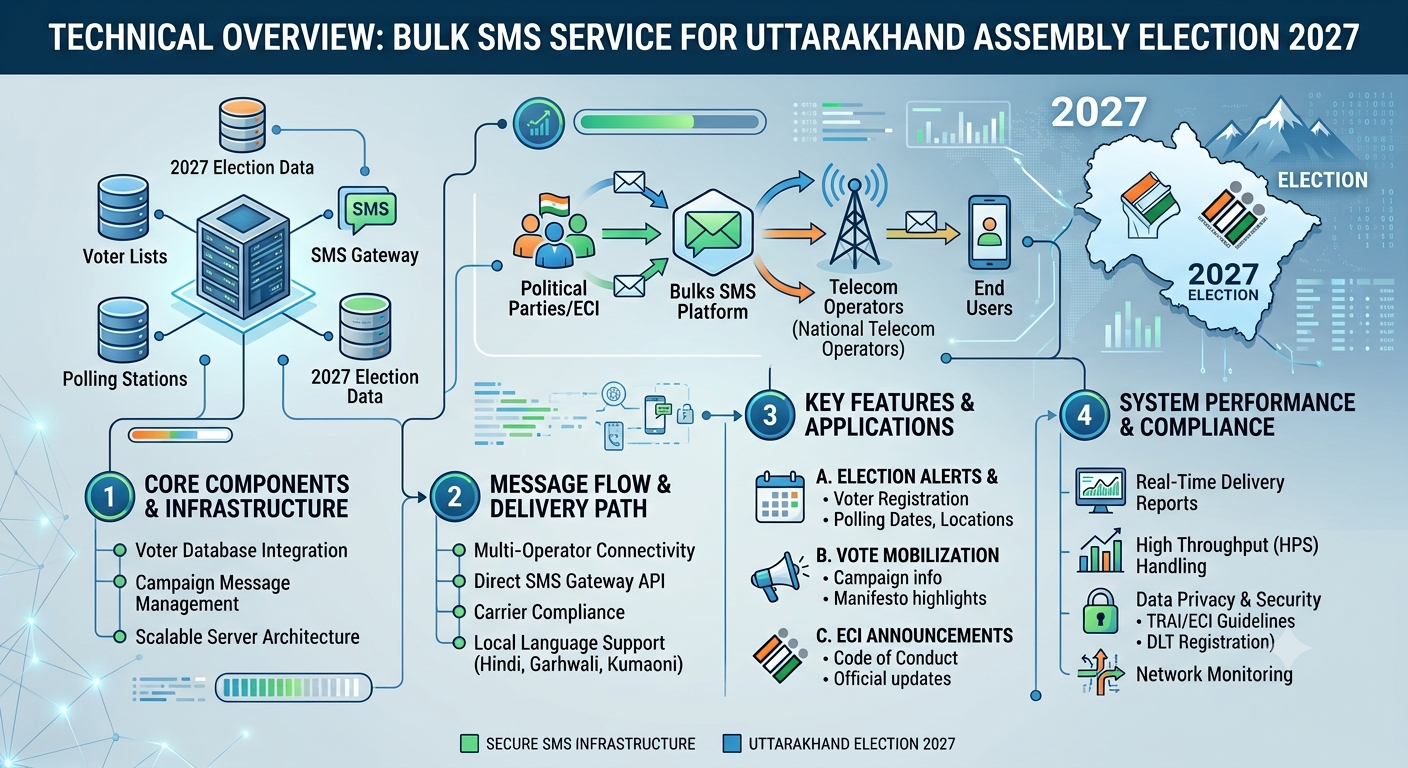
Hindi in Devanagari is the practical language for written messages. Garhwali and Kumaoni are spoken widely, and a short recorded greeting in the local speech can feel personal, but use a speaker from that area and test the recording before it goes out. Written SMS in Garhwali or Kumaoni is not common, so keep it to Hindi. Hindi uses Unicode, so test message parts on a phone. Before any large send, check names, dates, places and pronunciation.
Which channel should do which job?
Match the channel to the message, not the other way round. This is how we would split them for Uttarakhand.
| Channel | Best for in Uttarakhand | Watch out for |
|---|---|---|
| SMS | Dates, venues and polling-day facts, sent early to allow for delayed delivery; links to official information | Delays in coverage gaps; Unicode parts |
| Voice call (recorded) | Recorded greetings and reminders where reading is harder; local speech; keypad responses | Missed calls when phones are out of range; script length |
| IVR helpline (inbound) | Voter questions in Hindi, with a callback option for missed calls | Staffing the line and answering missed calls |
| WhatsApp Business Platform | Not available to political campaigns under Meta's policy | Vendors and older guides that still offer it |
How does a bulk voice call campaign work in a hill state?
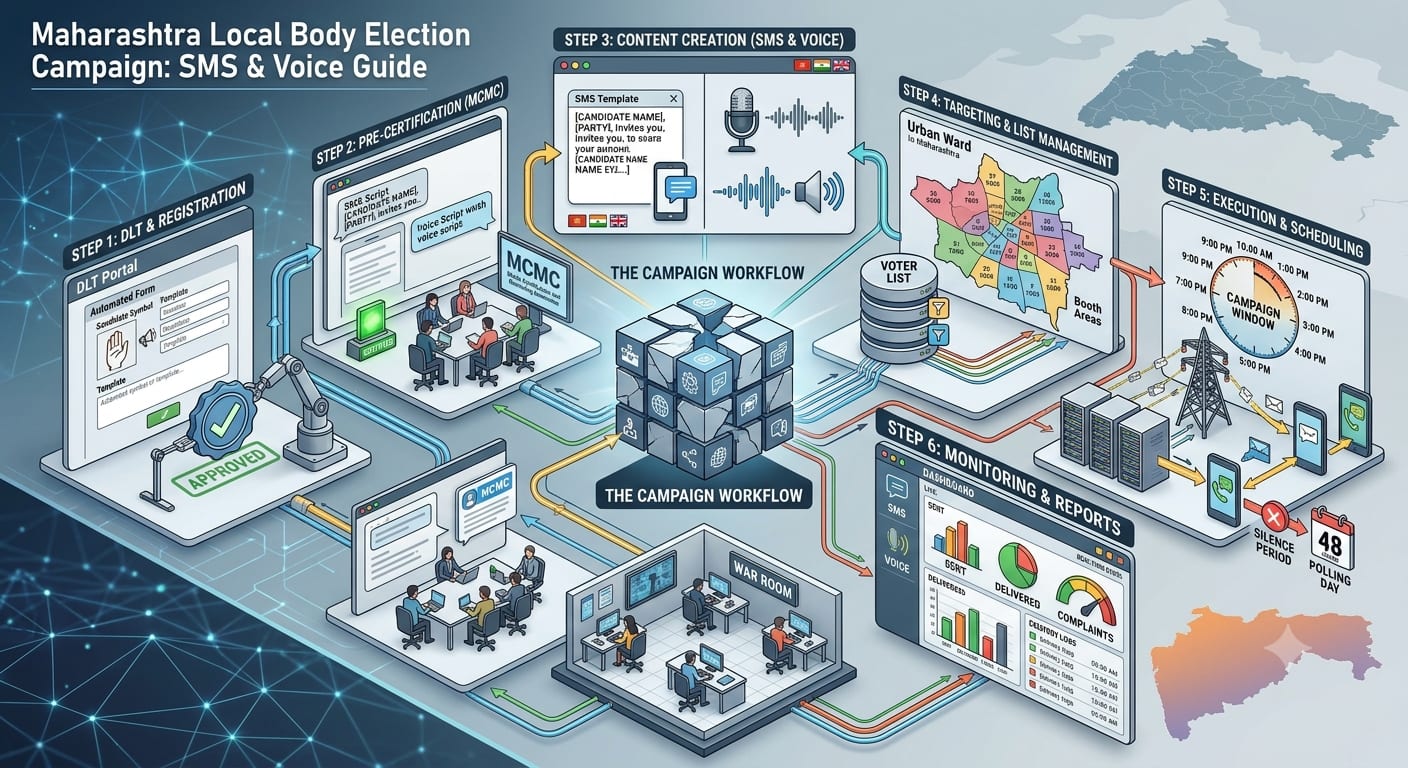
A bulk voice call, also called outbound dialling (OBD), plays a recorded message when the person answers. It does not need a smartphone or an app, which matters in hill areas. A campaign runs in six steps:
- Prepare the contact file. Organise numbers by constituency, district and area, and record where each came from.
- Record a short, clear message. Hindi, or a local speech greeting reviewed by someone from the area.
- Review the rules. Check the election, telecom and provider requirements, including whether the script needs certification.
- Configure the campaign. Choose the audience, recording and schedule.
- Launch. The system places the calls to the selected group.
- Read the reports. Ask for call attempts, connected and unanswered calls and retries, then send workers where response is low.
Some voice platforms can capture keypad responses, such as "press 1 for information, press 2 for event details, press 3 for a callback". What is available depends on the provider and the setup, so ask. Any response option should have a clear purpose and respect privacy rules. Our guide to bulk voice calls for political campaigns goes deeper, and an inbound line is covered in the IVR voter helpline guide.
What about WhatsApp in an Uttarakhand campaign?
Many campaigns ask for bulk WhatsApp to share posters, videos and documents. An earlier guide on this site described how. That advice is out of date. Meta's WhatsApp Business Messaging Policy, last updated 23 September 2026, prohibits use of the WhatsApp Business Platform by political parties, politicians, political candidates and political campaigns, and by services offered for political campaign strategy. Read what the policy says and what it leaves open before you plan around it.
The needs behind the request can be met another way:
- Posters, videos and documents: host them on the campaign's own website or official pages and send the link by SMS.
- Event announcements and schedule changes: use SMS, with a worker's phone number.
- Audio messages: use a recorded voice call.
- Volunteer coordination: use SMS or a short voice message to the volunteer list, with consent.
- The state, district, constituency and local-team structure: keep it in your contact file. It works for any channel.
How do the rules apply to SMS and voice in Uttarakhand?
The same national rules apply everywhere. The Model Code of Conduct takes effect on announcement of the schedule (Press Information Bureau). Messages go through a registered sender and approved templates under TRAI's regulations; see our guide to DLT registration for political party sender IDs. Political advertisements on electronic media may need pre-certification, and a March 2026 report says the Commission's order for that round of polls covered bulk SMS and voice (newsonair.gov.in). Ask the District Election Officer's office what applies to your election. Do not assume that a message allowed at one stage is allowed at another: check each message against the latest instructions.
The 48-hour silence period applies to the polling area, so if the election is held in phases, it starts at different times in different constituencies. Check the hours for each seat. Our guide to the 48-hour silence period explains the detail.
How should a hill-state campaign schedule its sends?
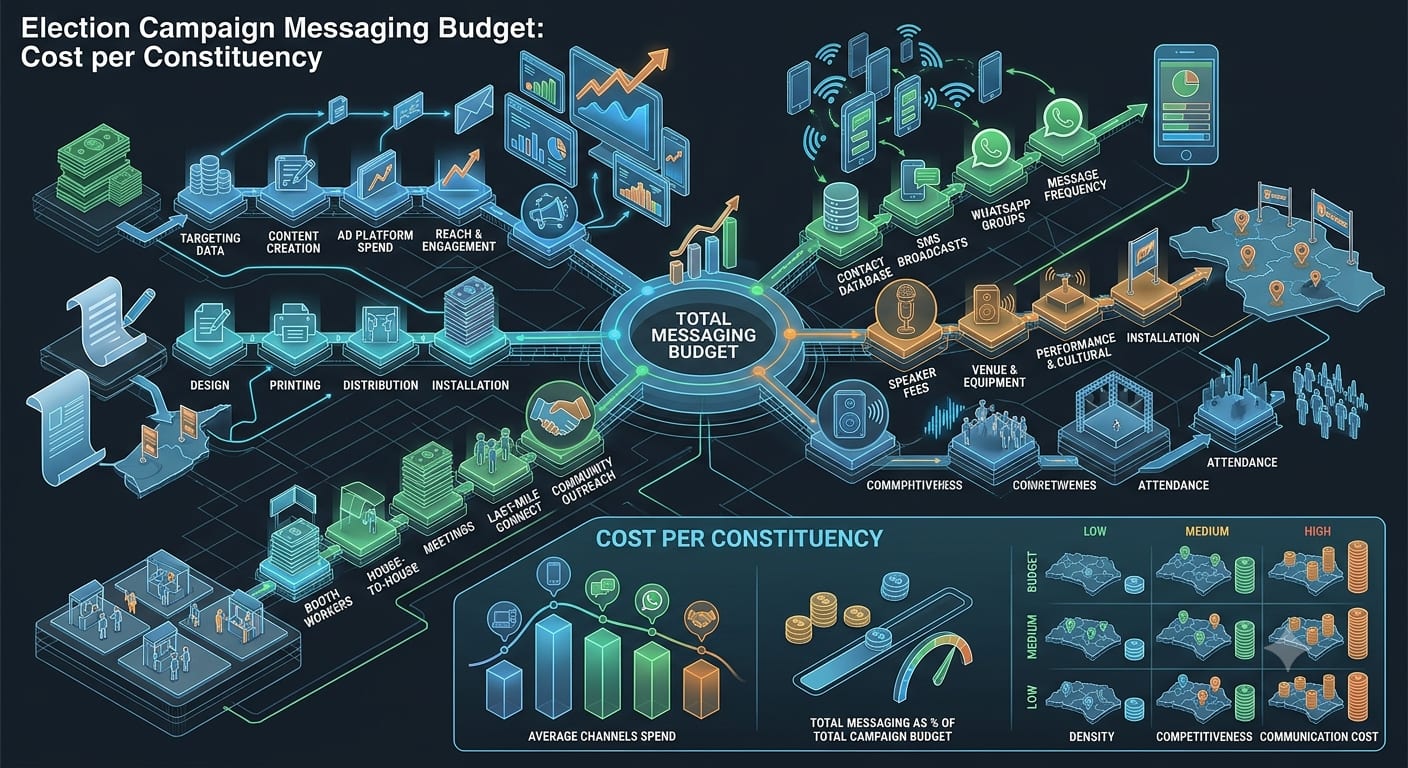
Build a calendar that assumes delay and repetition. Send the first notice well ahead of a meeting, a short reminder the day before and a final one on the morning. Use voice for the reminder in areas where workers tell you people respond to calls. Always record who sent what, because disputes about a missed notice are easier to settle with a log. Phase the campaign: awareness first (candidate introduction and local priorities), then engagement (meetings, events, volunteers), then election-period communication, where every message is reviewed against the latest Election Commission instructions. For the rest of the planning, see election campaign messaging budgets.
What should you ask an Uttarakhand messaging provider?
Ask about call connectivity, reporting, clear voice playback, Hindi and local-language support, keypad response options, high-volume capacity, support hours, data security and compliance assistance, and ask for the answers in writing. Do not accept a provider that offers WhatsApp broadcasts to voters without addressing the policy. Our guide to choosing a bulk messaging vendor for election campaigns has the full list.
A worked example (hypothetical)
A candidate in a hill constituency has 9,000 traceable numbers. This is an invented example. The team sends the first SMS about a village meeting ten days ahead, with the venue and a worker's phone number. A second SMS goes out the day before. In four booths where workers report poor coverage, a volunteer calls people directly. The voice reminder is recorded in simple Hindi with a Garhwali greeting from a local volunteer. The poster sits on the campaign's website and is linked in the SMS. The office logs every send and every call. Two villages tell the team they never received the first SMS, and the log shows it was delivered late, so the team repeats the notice by phone.
Common mistakes in Uttarakhand campaign messaging
- Last-minute SMS in hill areas. Delivery may be delayed.
- One plan for hills and plains. Coverage and habits differ.
- Untested local-speech recordings. A wrong accent can put people off.
- No log. You cannot settle disputes about missed notices.
- Late registration. Do it before the announcement.
- Bought lists. You cannot show consent.
- WhatsApp Business broadcasts. Meta's policy bars political campaigns.
Frequently asked questions
How many constituencies does Uttarakhand have?
70 assembly constituencies, across hill districts and the plains. See our guide to the 2027 state assembly elections for the seat counts and expected timeline, and check the Election Commission for the official schedule.
Can an Uttarakhand campaign use bulk WhatsApp?
Not through the WhatsApp Business Platform. Meta's policy, last updated 23 September 2026, prohibits its use by political parties, candidates and campaigns. Use SMS and voice, and link to your own website for posters and documents.
Does SMS work in remote Uttarakhand villages?
It works where there is coverage, and a message may arrive late if the phone is out of range. Send early, repeat once and use workers or calls as a fallback.
Which language should Uttarakhand campaign messages use?
Hindi in Devanagari for written messages. A short recorded greeting in Garhwali or Kumaoni can help on voice, if a local speaker records and tests it.
Is voice better than SMS in the hills?
It can be, where reading is harder, but a call also fails when the phone is out of range. Use both, and have workers follow up on missed calls.
When must we stop bulk messages before polling?
When the 48-hour silence period begins in the polling area. Check the hours for your constituency, and plan your last send well before them.
Sources checked
All checked on 25 October 2026.
- Press Information Bureau: Announcement of schedule for general elections 2024 (16 March 2024) (code of conduct takes effect on announcement)
- Election Commission of India press note ECI/PN/38/2024 (2 April 2024) (Section 126 text)
- All India Radio News: EC mandates pre-certification of political ads (21 March 2026) (news report; the Commission's own order was not found)
- The Tribune: Bihar polls, bulk SMS and voice messages during silence period (October 2025) (news report of an Election Commission note)
- TRAI, consolidated Telecom Commercial Communications Customer Preference Regulations, 2018 (registered senders and templates)
- Meta, WhatsApp Business Messaging Policy (last updated 23 September 2026) (Policy on Government and Political Use)
If you are planning Uttarakhand campaign messaging and want to talk through registration, certification and timing, you can reach our team through the contact page.