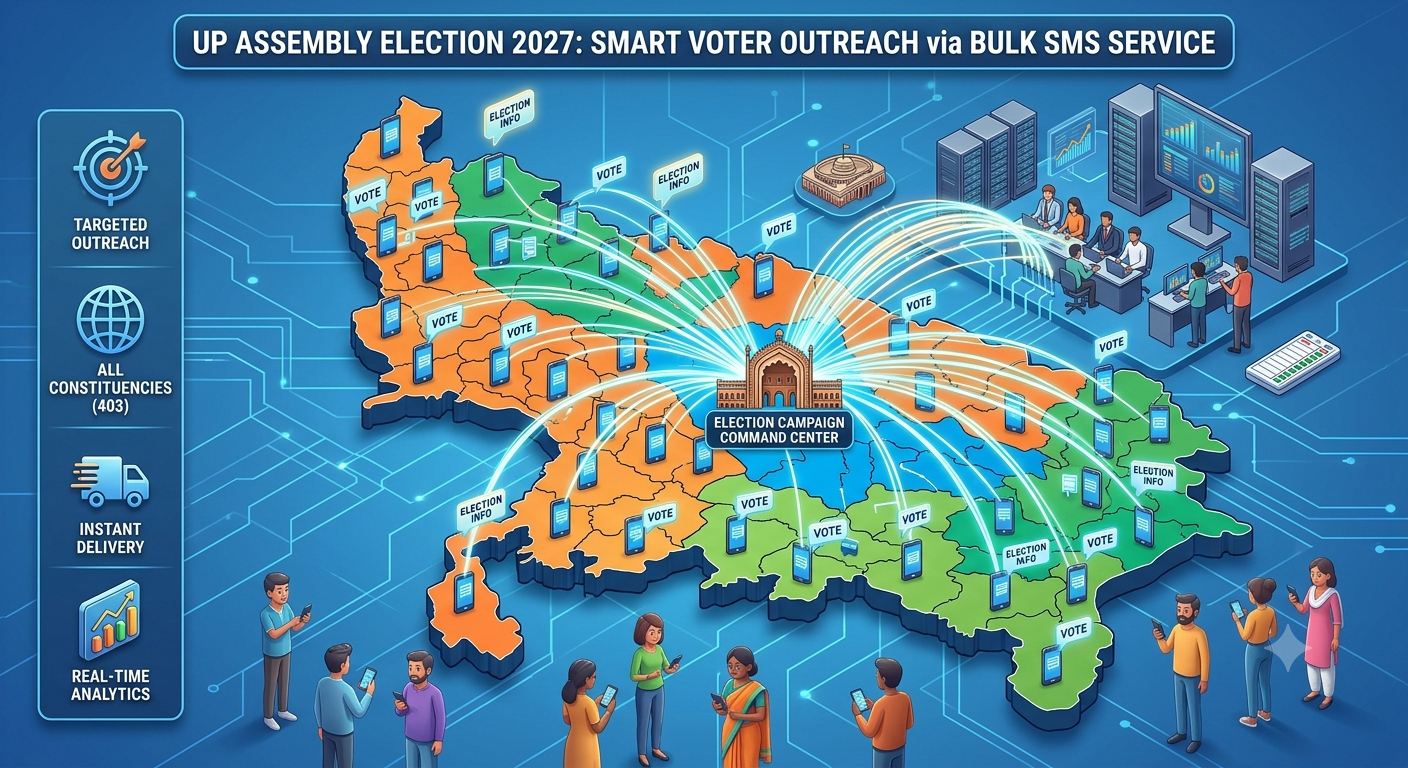
For the Uttar Pradesh election 2027 campaign, plan SMS for dates and venues, recorded voice calls for voters who respond better to speech, and an inbound helpline for questions. Work constituency by constituency across 403 seats, in Hindi first, through a registered sender, and check certification and the 48-hour silence period for each polling phase. WhatsApp's business platform is not open to political campaigns.
By Rohit Jadhav. Last reviewed 25 October 2026. This is operational guidance, not legal advice. Rules change, so confirm the current requirements for your election.
Uttar Pradesh sends 403 members to the Legislative Assembly, the largest assembly among the states in the 2027 cycle. That scale makes a UP election 2027 campaign a logistics problem as much as a political one. This single guide covers the three channels people ask about, SMS, voice calls and WhatsApp, how to plan them across such a state, what the rules require and where teams go wrong. It is part of our series on election campaign messaging rules. For help with the sending side, see our election campaign services in Uttar Pradesh. More guides are under Election Campaigns.
What does a 403-seat election mean for messaging?
It means you cannot run one campaign. Each constituency has its own candidate, its own issues and its own polling date if the election is held in phases. UP assembly elections have been held in several phases in the past, and the Commission announces the schedule for each election. Our guide to the 2027 state assembly elections lists the seat counts and tells you where to find the official schedule.
The practical consequence is that contact lists, scripts and calendars should be built per constituency, or per cluster of neighbouring constituencies that share a polling date. A central team can set the standards: templates, approvals, opt-out handling and reporting. Local teams then fill in the names, venues and issues. A campaign organising meetings in Lucknow, Varanasi, Agra, Kanpur, Gorakhpur or Prayagraj needs different venues, dates and approved material for each. Also check boundaries before you rely on last cycle's maps. Our delimitation guide explains why.
How should the campaign be organised across 403 constituencies?
Use levels: state-level coordination, district-level planning, constituency teams and local event and volunteer coordination, with one place for language review, approval and reporting. Give every level an owner for the approved templates, the contact list and the opt-out record.
Keep the contact records simple and lawful. Useful fields are a contact or volunteer reference, constituency or district, source of the number and the date it was collected, communication permissions, language preference where the person gave it, the owning team, message and call history and opt-out status. Do not collect more than you need, and do not assume that a phone number tells you a person's location, language or political leaning. Before anything is scheduled, confirm the date, time, venue and contact details, and have a speaker of the language review the text.
Which language should UP campaign messages use?
Hindi in Devanagari for most of the state, Urdu in areas where voters read it, and English for urban professionals. Spoken dialects such as Awadhi, Bhojpuri and Braj matter for voice calls: a recording in the local speech can feel more personal than standard Hindi, but test it with people from the area first. SMS in Hindi uses Unicode, so check the message-part count on a phone before a large send. For more on regional language messaging, see multilingual campaign messaging.
Which channel should do which job?
Match the channel to the message, not the other way round. The three channels have different strengths, and one of them is closed to political campaigns.
| Need | SMS | Voice call | WhatsApp Business Platform |
|---|---|---|---|
| Short announcements | Well suited | Possible | Not available to political campaigns |
| Event reminders | Well suited | Suitable | Not available |
| Posters, videos, documents | Send a link to your own website | Not applicable | Not available |
| Recorded audio | Not directly | Well suited | Not available |
| Needs mobile internet | No | No | Yes |
| Reporting | Delivery reports; depends on provider | Call reports; depends on provider | Not applicable |
These are general characteristics, not guarantees of delivery, engagement or results. A delivery report says a message arrived. It does not say the person read, understood or acted on it.
How does a bulk voice call campaign work in UP?
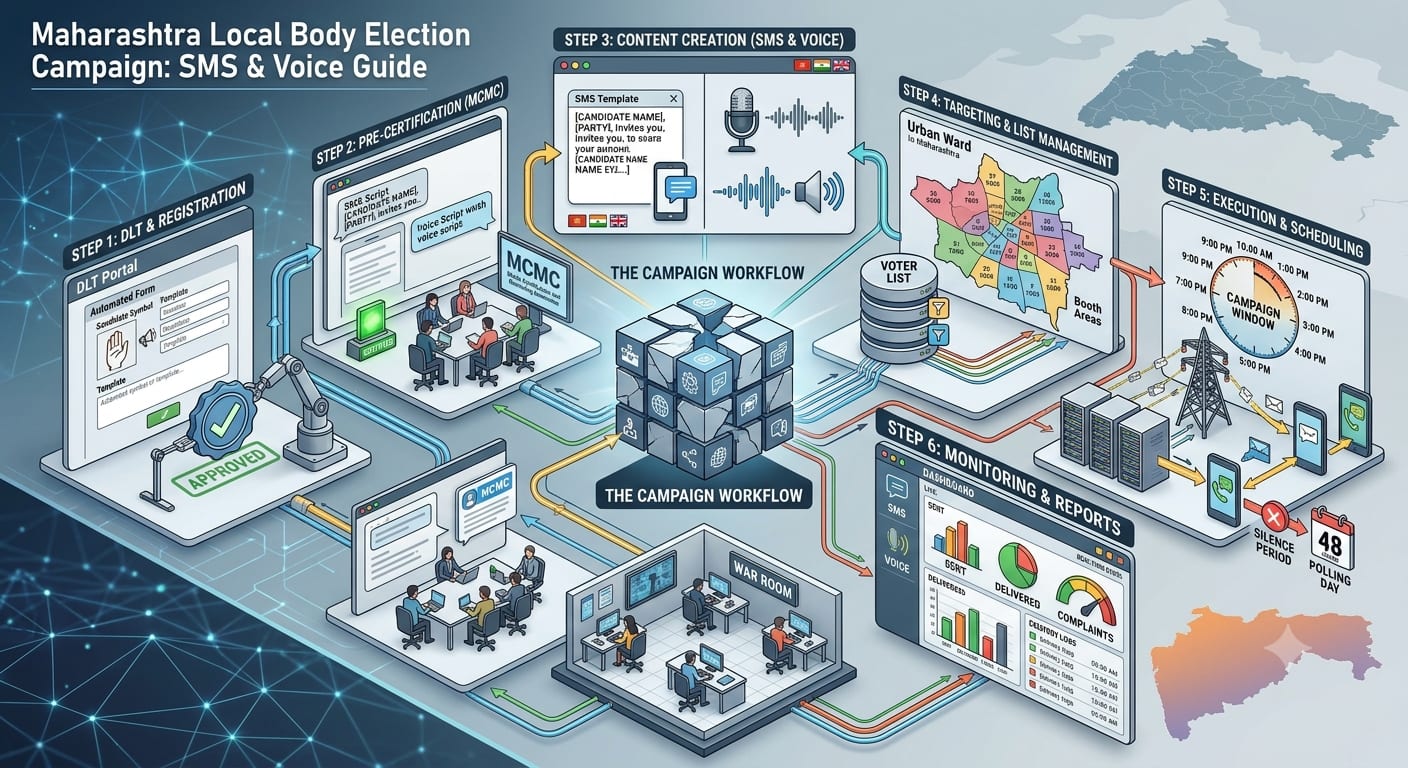
A bulk voice call, also called outbound dialling (OBD), places a call and plays a recorded message when it connects. It suits voters who prefer to listen, and it needs no mobile internet. A campaign runs in six steps:
- Prepare the contact records. Validate the list and confirm it can lawfully be used for this purpose.
- Record the message. Use clear audio and verify the script before recording.
- Complete the compliance checks. Telecom requirements, approvals, certification and election restrictions.
- Configure the campaign. Choose the audience, schedule and calling settings.
- Launch the calls. The system plays the recording when each call connects.
- Review the reports. Look at connection and completion figures. Not every call connects, and an answered call is not proof that someone listened to the end.
Typical uses are a recorded candidate message, public meeting announcements, schedule information and volunteer instructions. See bulk voice calls for political campaigns for scripts and timing, and the IVR voter helpline guide for inbound lines.
What about WhatsApp in a UP campaign?
Many campaigns ask for bulk WhatsApp to share posters, videos and manifesto PDFs, and an earlier version of this guide described how. That advice is out of date. Meta's WhatsApp Business Messaging Policy, last updated 23 September 2026, prohibits use of the WhatsApp Business Platform by political parties, politicians, political candidates and political campaigns, and by services offered for political campaign strategy. Read what the policy says and what it leaves open before you plan around it.
The needs behind the request can be met another way:
- Posters, graphics, videos and manifesto documents: host them on the campaign's own website or official pages and send the link by SMS. Check that the document is current and correctly attributed.
- Event details and schedule changes: use SMS.
- Audio from the candidate: use a recorded voice call.
- Volunteer instructions: use SMS or voice to the volunteer list, with consent.
How do the rules apply to SMS and voice in UP?
The same national rules apply everywhere. The Model Code of Conduct takes effect on announcement of the schedule (Press Information Bureau). Messages go through a registered sender and approved templates under TRAI's regulations; see our guide to DLT registration for political party sender IDs. Do not assume political messages are automatically either commercial or exempt: the regulation does not name them, and operators decide in practice.
Political advertisements on electronic media may need pre-certification by the Media Certification and Monitoring Committee. An earlier version of this guide cited an Election Commission press note dated 20 March 2026 that includes bulk SMS, voice messages and social media, and a report from All India Radio on 21 March 2026 describes the same order for that round of polls (newsonair.gov.in). Orders are issued election by election, so ask the District Election Officer's office what applies to yours.
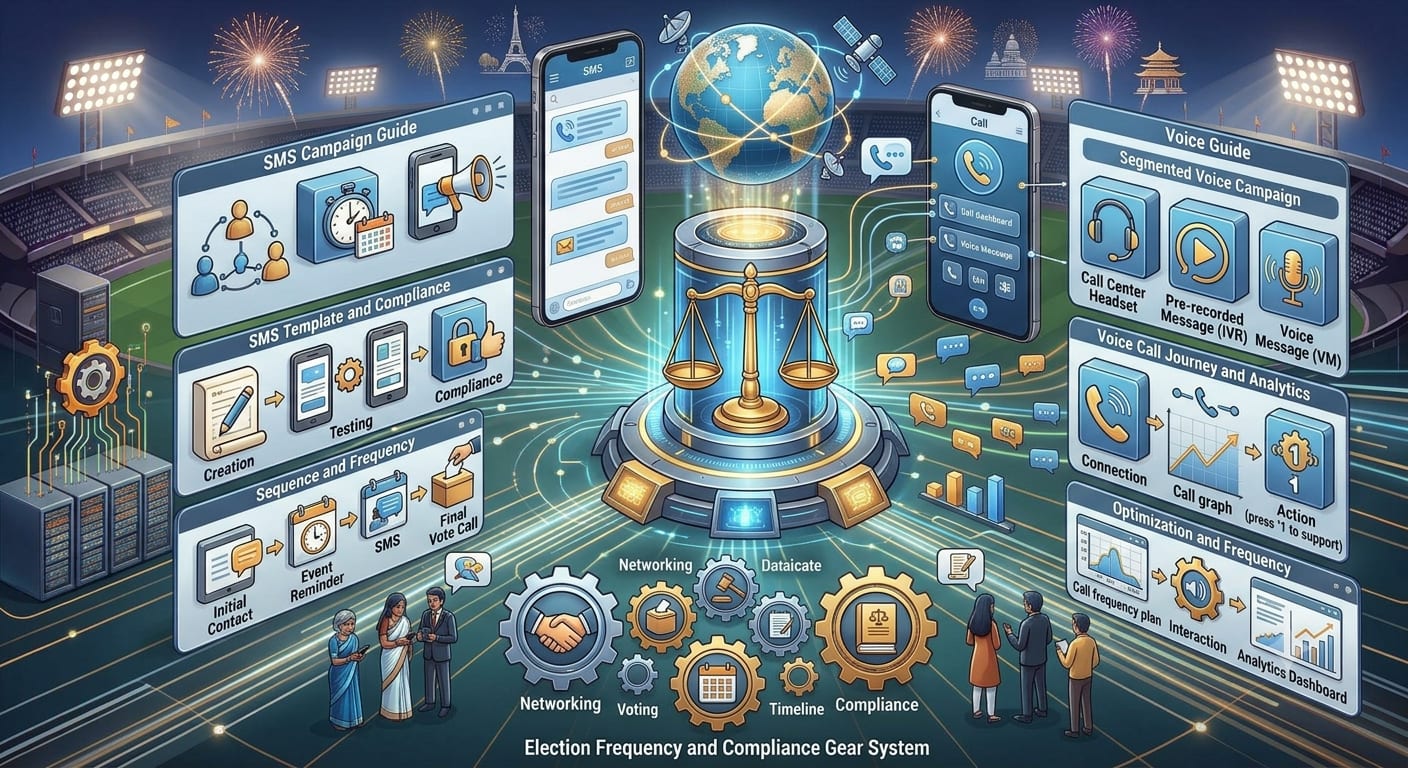
The 48-hour silence period applies to the polling area, so in a phased election it begins at different times in different constituencies. Check the hours for each seat you work in, not just the state. Our guide to the 48-hour silence period explains the detail, and the main guide to election campaign messaging rules lists every step. Keep records of approvals, schedules, invoices and what was sent.
How should a campaign organise a state this large?
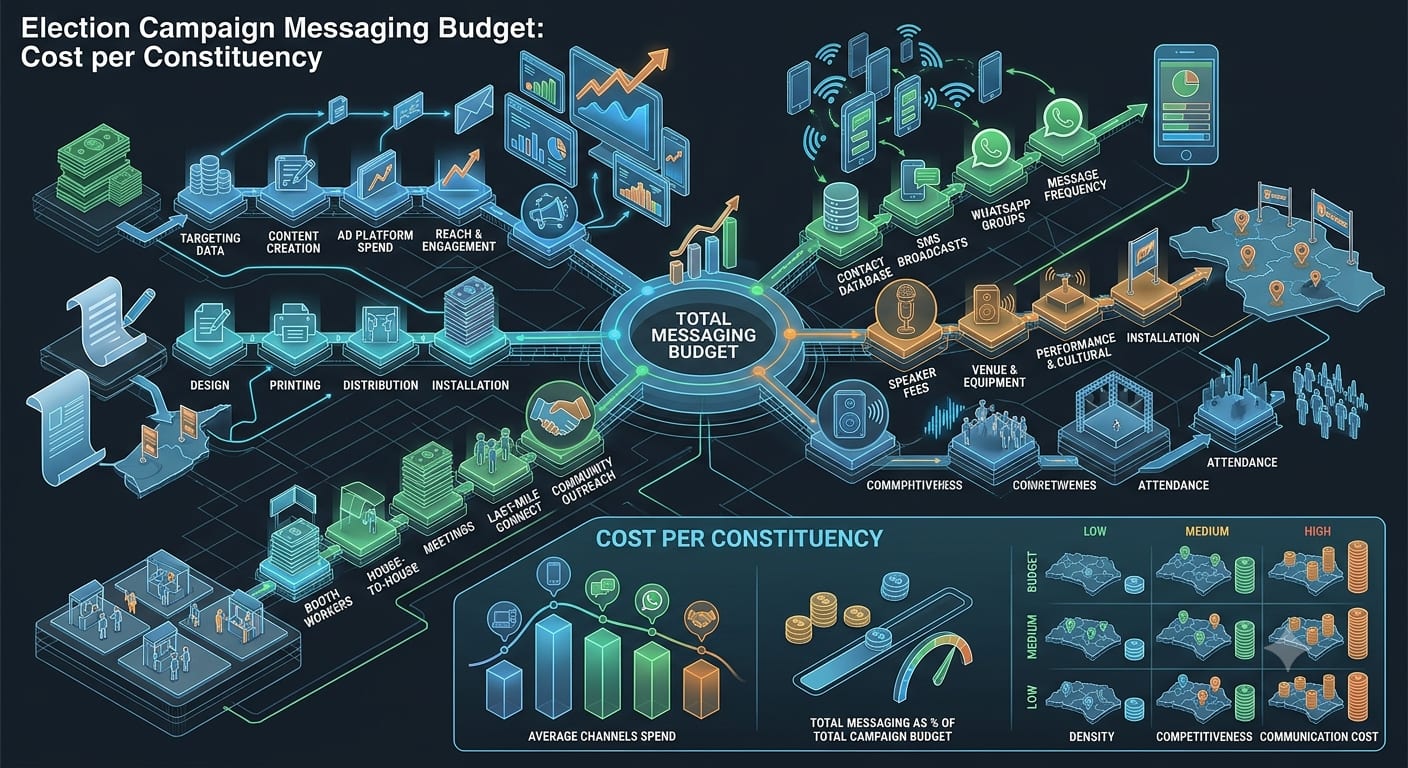
Split it into clusters. Group constituencies by polling date and by language profile, then give each cluster one owner. Run a small test send in each cluster before the main one, so that a template problem shows up in 500 messages and not 50,000. Work in four phases: preparation (responsibilities, verified contacts, permissions, approved content), distribution (the right channel for each message, with the same event details everywhere), operational coordination (changes to teams, a record of what went out) and review (delivery and call reports, issues logged). Use booth-level lists inside each constituency, as described in our booth-level voter outreach guide. For budgeting, see election campaign messaging budgets and election SMS campaign cost.
How do you choose a messaging provider for UP?
Ask which channels it supports, how campaigns are scheduled, which reports you actually get, which languages it handles, its real capacity and limits, how contact data is protected, how support works during a live campaign and what compliance help it offers. Remember that legal approval remains the campaign's responsibility, and that a provider offering WhatsApp broadcasts to voters has to explain the policy. Our guide to choosing a bulk messaging vendor for election campaigns has the full list.
A worked example (hypothetical)
A party's state office wants to run messaging for 40 constituencies in two polling phases. This is an invented example. It builds four clusters by phase and language, registers one sender and a library of templates, and submits scripts for certification on announcement day. Each cluster owner sends a 500-message test, checks delivery reports and corrects two Unicode templates that split into three parts. The main sends follow a calendar that ends before the silence period for each phase. Posters and the manifesto sit on the party's website and are linked in the SMS. The state office never sends one message to all 40 constituencies at once, because the first phase's silence period would already be running for some of them.
Common mistakes in UP campaign messaging
- One state-wide campaign. Seats, issues and polling dates differ.
- Ignoring phases. The silence period starts at different times.
- The same content on every channel. A short SMS and a recorded call need different formats.
- Treating delivery as engagement. Delivered, connected and read are different things.
- Dialect without testing. A recording that sounds wrong in one district can backfire.
- Late template approval and certification. Do them before the announcement.
- Bought numbers. You cannot show consent.
- No records. Keep approvals, schedules and invoices.
- Relying on WhatsApp Business broadcasts. The platform bars political campaigns.
Frequently asked questions
Which election messaging channels suit Uttar Pradesh?
SMS for dates and venues, recorded voice calls in the local language and an inbound helpline for questions. WhatsApp Business broadcasts are not an option for campaigns under Meta's policy. The mix depends on your voters and your booths.
Can SMS, WhatsApp and voice calls be used together in UP?
SMS and voice can be coordinated, with each channel given a role. WhatsApp's business platform is closed to political campaigns, so link to your own website from SMS for posters and documents.
How many constituencies does Uttar Pradesh have?
403 assembly constituencies, the largest number among the states in the 2027 cycle. Seat counts and the expected timeline are in our guide to the 2027 state assembly elections, and the Election Commission announces the official schedule.
Does the 48-hour silence period start on the same day across UP?
Not necessarily. It applies to the polling area, so in a phased election it begins at different times in different constituencies. Check the polling date for each seat you are working in.
Can campaigns reach rural UP with these services?
SMS and voice calls need no mobile internet to deliver their core message, which helps in rural areas. Actual reach depends on coverage, valid numbers and whether people answer.
Do campaign SMS in UP need certification?
The Commission may require pre-certification of political advertisements on electronic media, and a March 2026 report says its order for that round of polls covered bulk SMS and voice. Ask the District Election Officer's office.
Sources checked
All checked on 25 October 2026.
- Press Information Bureau: Announcement of schedule for general elections 2024 (16 March 2024) (code of conduct takes effect on announcement)
- Election Commission of India press note ECI/PN/38/2024 (2 April 2024) (Section 126 text)
- All India Radio News: EC mandates pre-certification of political ads (21 March 2026) (news report; the Commission's own order was not found)
- The Tribune: Bihar polls, bulk SMS and voice messages during silence period (October 2025) (news report of an Election Commission note)
- TRAI, consolidated Telecom Commercial Communications Customer Preference Regulations, 2018 (registered senders and templates)
- Meta, WhatsApp Business Messaging Policy (last updated 23 September 2026) (Policy on Government and Political Use)
If you are planning Uttar Pradesh campaign messaging and want to talk through registration, certification and timing, you can reach our team through the contact page.