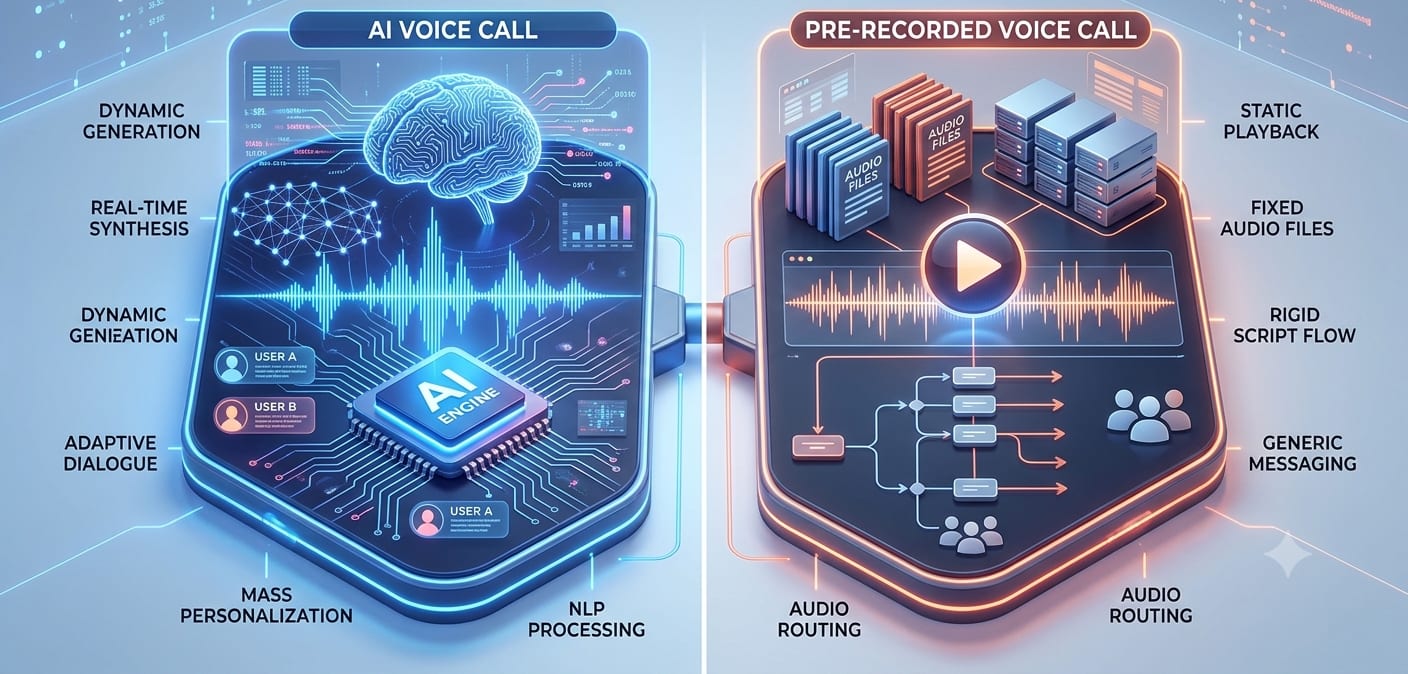

Quick answer: Use SMS for short, factual messages that people may want to keep, such as codes, receipts, links and addresses. Use bulk voice calls when the message is urgent, when the audience reads little or prefers its own language, or when you want a spoken reply on the keypad. Many businesses use both, with a call to get attention and a text to leave the details.
This is not a contest with one winner. Each channel is good at a different job, and the best results usually come from choosing per message. If you are new to voice, our guide to bulk voice call service in India explains how it works. The comparison below is about when to pick which.
The comparison at a glance
| Question | Bulk voice call | SMS |
|---|---|---|
| How is it received? | The phone rings and the person decides to answer | It arrives silently and waits to be read |
| Can the person keep the details? | No, they must remember or note them down | Yes, the text stays on the phone |
| Can it carry a link? | No | Yes, if the link is registered |
| Works for people who read little? | Yes, it is spoken | Only if they read the language used |
| Can the person reply? | With keypad options during the call | Only through a separate route you set up |
| Best for | Urgent news, reminders, surveys, outreach | Codes, receipts, short offers, links |
When voice calls work better
The message is urgent
A ringing phone is harder to ignore than a message that sits unread. For an emergency notice, a payment that is due today or a time-critical change, a call is more likely to get noticed quickly.
The audience reads little, or reads another language
A spoken message in the listener's own language reaches people who find text hard, and people who do not use smartphones or data. This is the main reason voice is used for rural and regional outreach. Our article on voice calls for rural voters shows this in practice.
You want an answer
A call can ask for a keypress, such as "press 1 to confirm". Our guide to press-1 voice campaigns explains how this works. Replying to a text needs a separate route, such as a number or a link.
When SMS works better
The person needs to keep the information
An address, a reference number, a booking code or a link is easier to use from a text. Nobody wants to note down a 10-digit number from a call.
The message is short and not urgent
A small offer, a receipt or a delivery update does not need to interrupt someone. A text lets them read it when they choose.
You need to send a link
A voice call cannot carry a clickable link. If the call is a reason to visit a page, send the link by text.
Cost and effort
Pricing for both channels varies by provider, volume and message type, so any figure quoted without those details should be treated with caution. As a general matter, a call uses more of a person's time than a text, and a recorded message has to be written for the ear. Our guide to writing a bulk voice call script shows how much work that takes. Ask your provider for the current rates for your volume.
Compliance is similar for both
Both channels fall under TRAI's regulations, and both need consent and a Do Not Disturb check for promotional use. A call that mixes a promotion into a service message is treated as promotional, and the same logic applies to text messages. Our summary of TRAI rules for bulk voice calls goes through the details.
Using both together
A simple pattern many businesses use: the call carries the urgent part, and a text follows with the details the person needs to keep.
- Call: "This is Sunrise Dental Clinic. Your appointment is tomorrow at 11. Press 1 to confirm."
- Text, sent after the call: the address, the time and a contact number.
The example is invented. Test it on a small group first and read the numbers in the campaign report, which our guide to voice call reports and metrics explains.
Which channel for which message
- One-time code or receipt: SMS.
- Emergency notice: voice call, followed by a text.
- Appointment reminder: either. A call with a confirm key suits people who respond to calls.
- Payment due reminder: a call for urgency, a text with the amount and the payment link.
- Survey or feedback: voice, with keypad answers.
- Offers with a link: SMS.
Nexcomm's bulk voice call service covers the voice side of this, with scheduling, retries and call logs.
Frequently asked questions
Is a voice call better than SMS?
Neither is better in general. Voice suits urgent, spoken and interactive messages, and SMS suits short messages that people need to keep.
Can I use both for the same campaign?
Yes. A call to get attention, followed by a text with the details, is a common pattern.
Do voice calls need an internet connection?
No. A voice call works on any phone that can receive calls, with no data or app.
Which is cheaper?
It depends on your provider, volume and message type. Ask for current rates for each rather than relying on a general claim.
Are the compliance rules the same?
Both are covered by TRAI's 2018 regulations, with consent and Do Not Disturb checks for promotional messages. The details of header registration and templates apply to SMS, and calling line identity rules apply to calls.
Sources checked
- Nexcomm's Voice Campaigns service page, for recorded and text-to-speech messages, keypad responses and call logs (checked 2 November 2026).
- TRAI, Telecom Commercial Communications Customer Preference Regulations, 2018, for the shared consent and Do Not Disturb framework.
- No price or response-rate figures are quoted because none were verified. The example is an invented illustration.
More in Voice and IVR guides.
Written by Rohit Jadhav. Last reviewed 2 November 2026.