🤖 How AI Chatbots Improve Customer Support on WhatsApp
In today's digital-first world, customers expect businesses to respond instantly, regardless of the time or communication channel. Long waiting times, missed inquiries, and inconsistent support can negatively impact customer satisfaction and even result in lost sales. As businesses scale, handling every customer conversation manually becomes increasingly challenging.
This is where a WhatsApp customer support chatbot makes a significant difference. Powered by Artificial Intelligence (AI), these chatbots automate conversations, answer customer queries, and provide instant assistance 24/7. They not only improve customer satisfaction but also help businesses reduce operational costs and increase team productivity.
In this comprehensive guide, you'll learn how AI-powered WhatsApp chatbots improve customer support, their key features, real-world applications, and best practices for successful implementation.
What Is a WhatsApp Customer Support Chatbot?
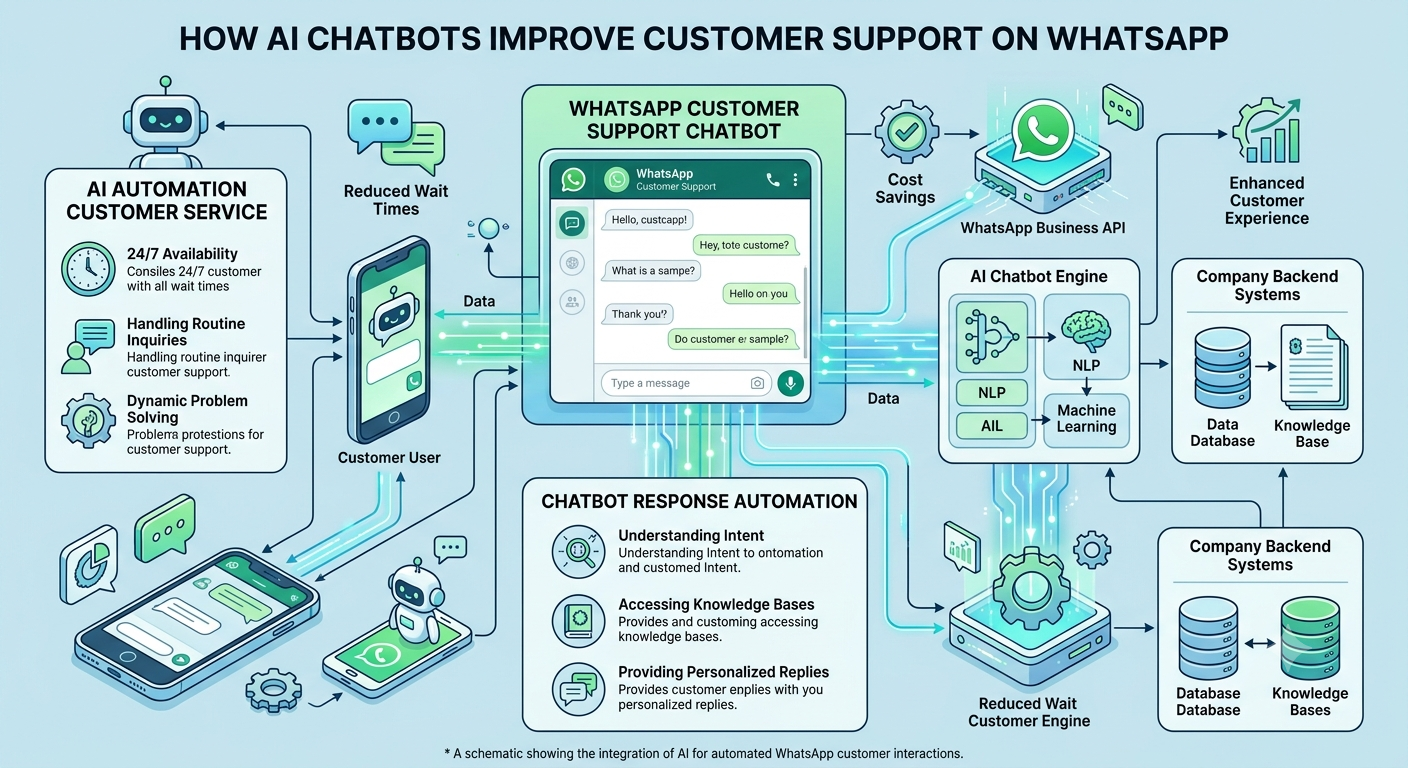
A WhatsApp customer support chatbot is an AI-powered virtual assistant integrated with the WhatsApp Business Platform. It uses Natural Language Processing (NLP) and Machine Learning (ML) to understand customer questions and provide intelligent, human-like responses.
Unlike traditional rule-based chatbots that only follow predefined scripts, AI chatbots can:
- Understand customer intent
- Respond to natural language
- Personalize conversations
- Learn from previous interactions
- Automate repetitive support tasks
- Transfer complex conversations to human agents
This enables businesses to deliver fast, accurate, and consistent customer support at scale.
Why Businesses Are Moving to AI-Powered Customer Support
Customer expectations have changed dramatically.
Modern consumers expect:
- Instant replies
- 24/7 availability
- Personalized interactions
- Faster issue resolution
- Convenient messaging support
Meeting these expectations with only human agents often requires significant investment in staffing and training. AI-powered chatbots solve this challenge by automating routine conversations while allowing support teams to focus on more complex issues.
How AI Automation Improves Customer Service on WhatsApp
Implementing AI automation for customer service offers numerous advantages beyond simply answering frequently asked questions.
Let's explore the key benefits.
1. 24/7 Customer Support
One of the biggest advantages of a WhatsApp customer support chatbot is round-the-clock availability.
Unlike human agents, AI chatbots never take breaks, making them ideal for:
- After-hours inquiries
- Weekend support
- Holiday assistance
- Global customers across different time zones
Customers receive immediate responses whenever they need assistance.
2. Instant Response to Customer Queries
Customers value speed.
AI-powered chatbots respond within seconds, significantly reducing waiting times compared to traditional customer support.
Typical requests handled instantly include:
- Business hours
- Pricing information
- Product details
- Order status
- Appointment scheduling
- Delivery updates
Fast responses improve customer satisfaction and increase trust.
3. Chatbot Response Automation Reduces Manual Work
One of the biggest benefits of chatbot response automation is eliminating repetitive support tasks.
The chatbot automatically handles:
- Frequently Asked Questions (FAQs)
- Product information
- Shipping inquiries
- Order tracking
- Payment confirmations
- Appointment reminders
- Account assistance
This allows customer support teams to focus on more valuable and complex interactions.
4. Consistent Customer Experience
Human responses can vary depending on the support representative.
AI chatbots provide:
- Standardized information
- Accurate answers
- Consistent tone
- Uniform customer experience
Every customer receives reliable support regardless of when they contact the business.
5. Personalized Customer Conversations
Modern AI chatbots can integrate with CRM systems and customer databases.
This allows them to personalize conversations using:
- Customer names
- Previous purchases
- Order history
- Service preferences
- Conversation history
Personalized support creates stronger customer relationships and improves satisfaction.
6. Intelligent Query Understanding
Unlike traditional bots that rely only on keywords, AI chatbots understand customer intent.
For example, these questions all have the same meaning:
- Where is my order?
- Can I track my package?
- Has my shipment been dispatched?
- When will my order arrive?
The chatbot understands the context and provides the appropriate response.
7. Smart Escalation to Human Agents
AI doesn't replace human support—it enhances it.
When the chatbot encounters:
- Complex complaints
- Technical issues
- Billing disputes
- High-value sales inquiries
It transfers the conversation to a live support representative along with the complete chat history.
This creates a seamless customer experience.
8. Supports Thousands of Customers Simultaneously
Human support teams have limitations.
An AI-powered WhatsApp customer support chatbot can handle thousands of conversations at the same time without affecting response quality.
This makes it ideal for:
- E-commerce sales events
- Product launches
- Festival campaigns
- Customer service peaks
9. Automated Follow-Ups
AI automation doesn't stop after the first conversation.
Businesses can automate follow-up messages such as:
- Order confirmations
- Delivery updates
- Feedback requests
- Payment reminders
- Renewal notifications
- Promotional offers
This keeps customers engaged while reducing manual effort.
10. Valuable Customer Insights
AI chatbot platforms provide detailed analytics that help businesses improve support operations.
Useful insights include:
- Most common customer questions
- Peak support hours
- Customer satisfaction
- Response times
- Resolution rates
- Conversation completion rates
These analytics help businesses continuously optimize customer service.
Industries Benefiting from WhatsApp Customer Support Chatbots
AI-powered chatbots are transforming customer support across many industries.
E-commerce
- Product recommendations
- Order tracking
- Return requests
- Payment updates
Healthcare
- Appointment booking
- Doctor availability
- Prescription reminders
- Patient support
Education
- Admission inquiries
- Course details
- Fee reminders
- Student assistance
Banking & Finance
- Account support
- Transaction alerts
- Loan inquiries
- Customer verification
Real Estate
- Property inquiries
- Site visit scheduling
- Lead qualification
- Customer follow-ups
Travel & Hospitality
- Booking confirmations
- Reservation updates
- Travel assistance
- Customer support
Essential Features of an AI Customer Support Chatbot
When choosing a chatbot platform, look for features such as:
AI-Powered Conversations
Understand natural customer language instead of relying only on keywords.
CRM Integration
Access customer history and personalize responses.
Multi-Language Support
Serve customers in different languages.
Live Agent Handover
Transfer complex conversations to human representatives.
Analytics Dashboard
Track chatbot performance and customer engagement.
API Integration
Connect with business systems such as CRM, ERP, eCommerce platforms, and payment gateways.
Best Practices for Successful Chatbot Response Automation
To maximize chatbot effectiveness:
- Define clear support goals.
- Keep conversations simple and natural.
- Personalize customer interactions.
- Regularly update FAQs and chatbot knowledge.
- Monitor chatbot analytics.
- Test chatbot flows frequently.
- Always provide an option to speak with a human agent.
These practices ensure both automation efficiency and customer satisfaction.
Common Mistakes to Avoid
Many businesses fail to get the best results because they:
- Overcomplicate chatbot conversations
- Ignore chatbot training
- Don't update knowledge bases
- Fail to monitor analytics
- Skip CRM integration
- Offer no human escalation option
Avoiding these mistakes significantly improves chatbot performance.
Future of AI Automation in Customer Service
AI continues to redefine customer support.
Emerging trends include:
- Voice-enabled WhatsApp assistants
- Sentiment analysis
- Predictive customer support
- AI-powered multilingual conversations
- Hyper-personalized recommendations
- Intelligent workflow automation
Businesses adopting AI today will be better prepared to meet tomorrow's customer expectations.