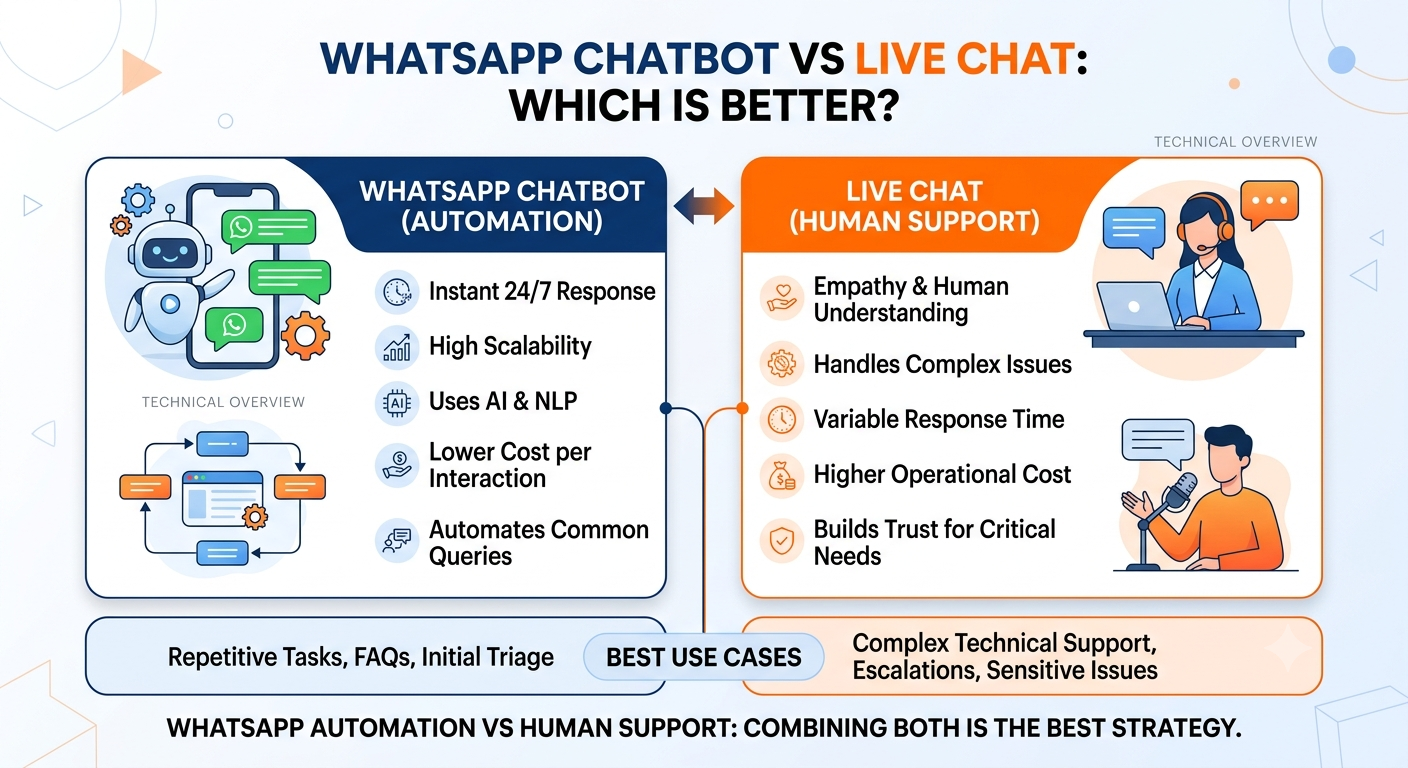
🤖 WhatsApp Chatbot vs Live Chat: Which Is Better for Your Business?
Customer communication has become one of the biggest competitive advantages for modern businesses. Customers expect instant replies, personalized support, and seamless experiences across digital channels. As businesses grow, managing thousands of customer conversations manually becomes increasingly difficult.
This has led many organizations to compare chatbot vs live chat solutions. Should you invest in an AI-powered WhatsApp chatbot that automates customer interactions, or should you rely on human agents to provide personalized support?
The answer isn't always straightforward. Both options have unique strengths, and the right choice depends on your business goals, customer expectations, and support volume.
In this guide, we'll compare WhatsApp automation vs human support, explore the pros and cons of each, and help you determine the best customer communication strategy.
What Is a WhatsApp Chatbot?
A WhatsApp chatbot is an AI-powered virtual assistant that communicates with customers through the WhatsApp Business Platform.
It can automatically:
- Answer frequently asked questions
- Capture leads
- Recommend products
- Track orders
- Schedule appointments
- Send payment links
- Provide customer support
- Route conversations to human agents when required
Modern AI chatbots use Natural Language Processing (NLP) to understand customer intent and deliver intelligent responses.
What Is Live Chat?
Live chat connects customers directly with human support representatives through WhatsApp or another messaging platform.
Unlike chatbots, human agents can:
- Understand emotions
- Handle complex situations
- Negotiate pricing
- Resolve unique issues
- Build stronger customer relationships
Live chat offers a personalized experience but requires staff availability and operational resources.
Chatbot vs Live Chat: Key Differences
| Feature | WhatsApp Chatbot | Live Chat |
|---|---|---|
| Availability | 24/7 | Business hours or staffing schedule |
| Response Speed | Instant | Depends on agent availability |
| Scalability | Handles thousands of chats simultaneously | Limited by the number of support agents |
| Cost | Lower long-term operational cost | Higher staffing and training costs |
| Personalization | AI-driven personalization | Human empathy and contextual understanding |
| Complex Problem Solving | Limited for highly unique cases | Excellent for complex scenarios |
| Consistency | Consistent responses | May vary between agents |
| Lead Qualification | Fully automated | Manual process |
| Sales Support | Automated recommendations | Personalized consultation |
| Learning Capability | Improves with AI training | Improves through agent experience |
Advantages of WhatsApp Chatbots
When comparing chatbot vs live chat, chatbots excel in automation and efficiency.
1. 24/7 Customer Support
Customers receive instant assistance anytime, including weekends and holidays.
No inquiry goes unanswered.
2. Instant Responses
AI chatbots respond within seconds, reducing customer waiting time and improving satisfaction.
3. Lower Operational Costs
One chatbot can handle thousands of conversations simultaneously without increasing staffing costs.
4. Automated Lead Generation
Chatbots automatically:
- Capture customer details
- Qualify leads
- Schedule demos
- Route prospects to sales teams
5. Consistent Customer Experience
Every customer receives accurate and standardized responses regardless of time or inquiry volume.
6. Business System Integration
Chatbots integrate with:
- CRM software
- E-commerce platforms
- Payment gateways
- ERP systems
- Helpdesk tools
This enables automated workflows and real-time information sharing.
Advantages of Live Chat
While automation is powerful, human interaction remains valuable.
Better Emotional Intelligence
Support agents understand customer emotions, frustrations, and unique situations better than AI.
Handles Complex Problems
Some customer issues require critical thinking, negotiation, or personalized decision-making.
Human agents excel in these situations.
Builds Trust
Customers often feel more comfortable discussing sensitive issues with a real person.
Personalized Sales Conversations
Sales representatives can tailor recommendations, negotiate pricing, and close high-value deals.
Greater Flexibility
Humans can adapt instantly when customers ask unexpected or highly specific questions.
Challenges of WhatsApp Chatbots
Although AI has improved significantly, chatbots still have limitations.
Common challenges include:
- Difficulty handling rare or highly complex requests
- Dependence on accurate training data
- Limited emotional understanding
- Requires ongoing optimization
For best results, businesses should provide a seamless transfer to live agents when necessary.
Challenges of Live Chat
Human support also comes with operational challenges.
These include:
- Higher staffing costs
- Limited working hours
- Longer response times during busy periods
- Training requirements
- Inconsistent service quality between agents
As customer inquiries increase, scaling live support becomes expensive.
WhatsApp Automation vs Human Support: Which Is Better?
When evaluating WhatsApp automation vs human support, the answer depends on your business needs.
Choose a WhatsApp Chatbot if you need:
- 24/7 customer support
- Automated lead generation
- Faster response times
- Lower operational costs
- High-volume customer handling
- Appointment scheduling
- FAQ automation
- Order tracking
Choose Live Chat if you need:
- Complex technical support
- Personalized consulting
- High-value sales discussions
- Complaint resolution
- Emotional customer interactions
- Negotiation and relationship building
The Best Approach: Combine Chatbots and Live Chat
For most businesses, the ideal solution is not choosing one over the other—it's combining both.
A hybrid customer support model works like this:
Step 1
The chatbot greets customers instantly.
Step 2
It answers common questions, captures lead information, and resolves routine requests.
Step 3
When the conversation becomes complex, it transfers the customer to a live support agent.
This approach provides:
- Faster service
- Lower support costs
- Better customer satisfaction
- Higher sales conversions
Industries That Benefit from Hybrid Support
A combination of chatbot automation and live chat is especially effective in:
E-commerce
- Product recommendations
- Order tracking
- Returns support
Healthcare
- Appointment booking
- Patient reminders
- Human consultation
Education
- Admission inquiries
- Student support
- Counselor assistance
Real Estate
- Lead qualification
- Property recommendations
- Sales consultation
Banking & Finance
- Account inquiries
- Loan applications
- Secure customer verification
SaaS Companies
- Demo scheduling
- Technical support
- Customer onboarding
Best Practices for Businesses
To maximize customer satisfaction:
- Automate repetitive tasks using AI chatbots.
- Offer live-agent support for complex issues.
- Personalize chatbot conversations.
- Integrate chatbot data with your CRM.
- Continuously monitor chatbot performance.
- Regularly update FAQs and knowledge bases.
- Train support teams to handle chatbot escalations efficiently.
Future of Customer Support
Artificial Intelligence is reshaping customer service.
Future developments include:
- AI voice assistants
- Sentiment analysis
- Predictive customer support
- Hyper-personalized conversations
- Intelligent workflow automation
- AI-assisted human agents
Rather than replacing human support, AI will increasingly enhance agent productivity and customer experience.