
RCS Messaging for Banks, NBFCs and Fintech Companies
Send fraud alerts with a direct call-support button and statements in a structured format, from a verified sender customers can trust.
What is RCS Messaging?
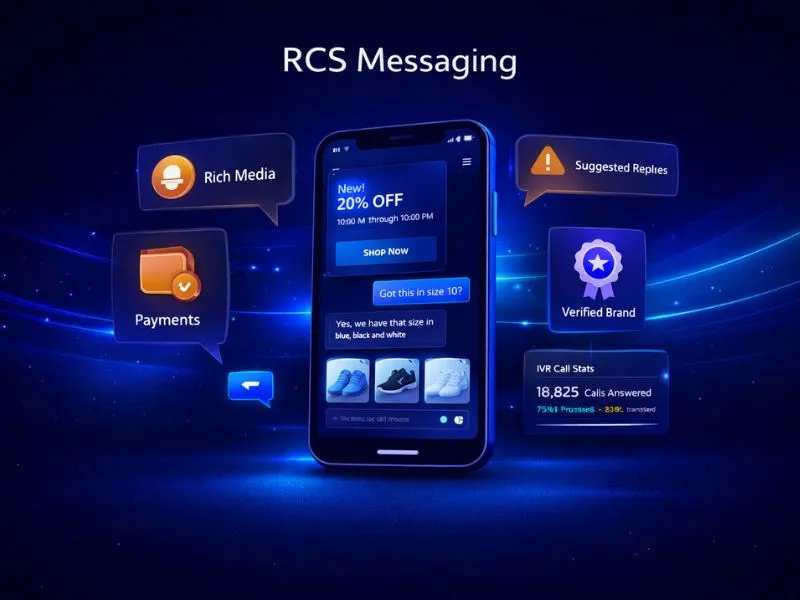
As a breakthrough in rich communication services india landscapes, RCS is the natural evolution of traditional SMS — bringing a significantly richer experience to the default messaging app on Android devices. With advanced rcs messaging for brands india solutions, businesses can send messages that include verified sender profiles displaying your brand logo and name, high-resolution images, videos, product carousels, and interactive buttons such as Suggested Replies and one-tap Actions. It delivers an app-like communication experience to your customers without asking them to install anything new.
Who is this for?
Banks, NBFCs, insurers and fintech companies that need customers to trust and act on their alerts.
RCS for Finance & NBFC
RCS messaging for banks, NBFCs and fintech companies puts a verified name and logo on every alert and adds a button to call support, so customers can tell a genuine message from an impersonation.
Impersonation is a constant risk for financial brands: a customer who receives a text claiming to be their bank has little to go on. With RCS, brand verification shows your name and logo before the message is opened. A fraud alert carries a Call Support button, a statement arrives in a structured format and a payment reminder can include a button to act on it.
RCS on Nexcomm's platform follows GSMA global standards and carrier-level regulations, with end-to-end encryption, spam protection and an opt-in requirement. Customers on phones without RCS, or who are offline, receive an SMS instead, so a critical alert still arrives. Reads and taps are reported, and one API serves both channels.
Financial messages fall into two kinds, and RCS handles both. Alerts and service messages, such as a transaction notice or a statement, need to be trusted. Offers and reminders, such as a loan offer or an EMI due date, need to be acted on. A verified sender with a logo covers the first, and a card with a clear button covers the second. Customers on iPhones or on phones without RCS receive an SMS, and an offline customer can be sent an SMS instead, so critical alerts are not skipped. Everything is opt-in and follows the channel's spam rules.
Lenders and banks also use vocabulary customers watch for: KYC reminders, EMI due dates, credit-limit changes, statement availability and fraud advisories. RCS can carry each in a clear card with a button, and the verified sender shows the institution's name. Customers on phones without RCS receive an SMS, so a KYC reminder or a fraud advisory reaches everyone. Reads and button taps show which reminders customers acted on, so a collections or service team knows where to follow up.
How Finance Teams Use RCS
Fraud alerts with a call button
A suspicious-transaction alert arrives under the bank's verified name with a Call Support button, so a customer can confirm it is genuine and reach a person in one tap.
Statements in a structured format
Card statements and account summaries are sent in a structured, secure format that is easier to read on a phone than a long block of text.
Payment reminders with an action
A reminder about a due payment carries a button to open the payment page or call the collections desk, which shortens the path from message to action.
Service updates under a verified name
Loan approvals, card dispatch updates and other service messages arrive with the lender's logo, which helps customers separate them from unsolicited messages.
EMI reminders with an action button
A reminder card carries the due date and a button that opens the payment page or calls the support line, which shortens the path from message to payment.
Frequently Asked Questions
Find Services Available Near You
Explore our service availability across major cities, states, and industries.
Education & Coaching Institutes
Student engagement & admissions
Real Estate Developers & Brokers
Property alerts & lead generation
Healthcare & Hospitals
Appointment reminders & patient care
E-commerce & Retail
Order updates & promotional offers
Finance & NBFC
Secure transactions & fraud alerts
Travel & Hospitality
Booking confirmations & travel updates
Manufacturing & Industrial
Supply chain & workforce management
IT & SaaS Companies
Product updates & user onboarding
Event Management
Event updates & ticket delivery
Logistics, Transport & Courier
Shipment alerts & delivery coordination
Two-Wheeler & Car Showrooms
Test drives, bookings & service reminders
Tours & Holiday Packages
Holiday enquiries, itineraries & booking follow-ups
Modernize Your Customer Communication
Switch to RCS today and deliver app-like experiences directly to the inbox.
Start RCS Pilot